Why Your Brand Gets Different Citation Rankings Across ChatGPT, Perplexity, and Google AI – And How to Fix It
Why Your Brand Gets Different Citation Rankings Across ChatGPT, Perplexity, and Google AI – And How to Fix It
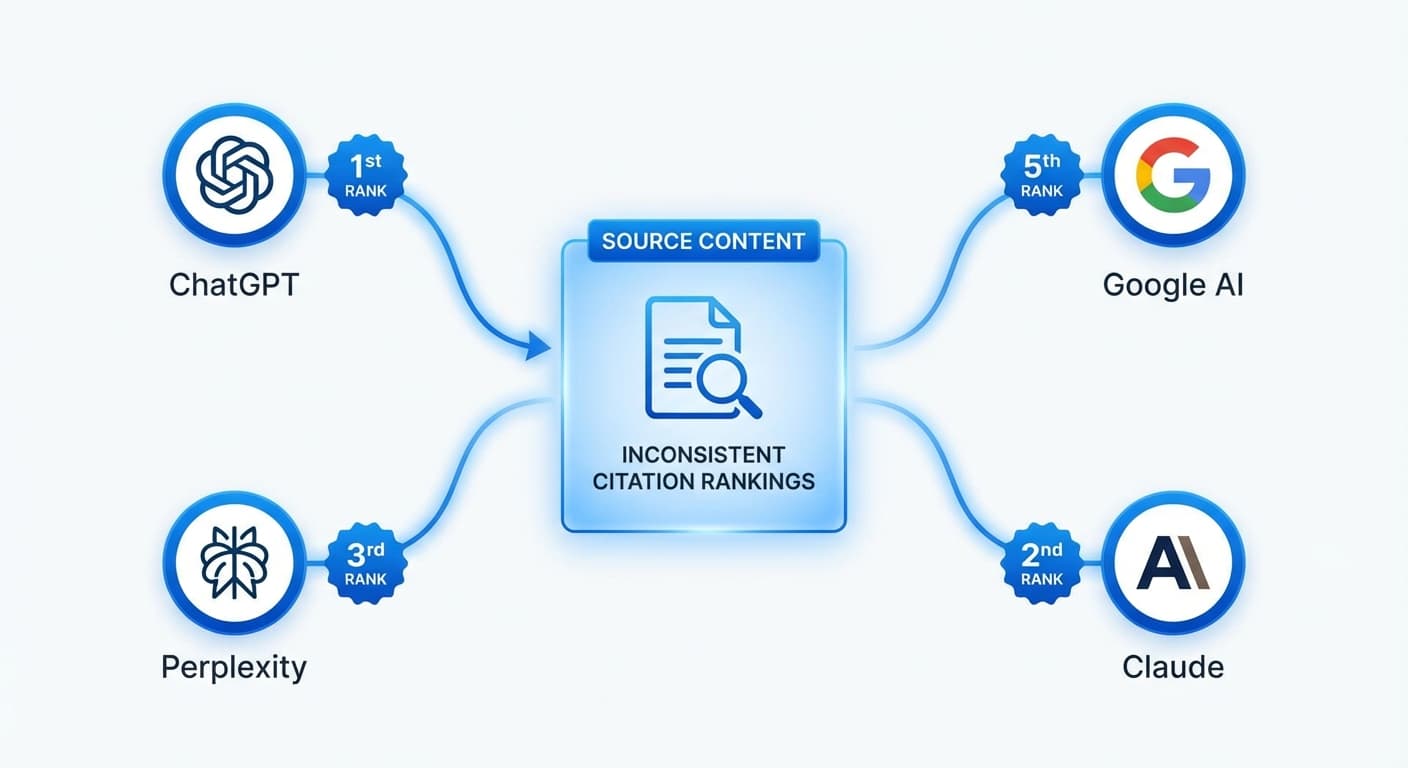
If you've been tracking your brand's visibility across AI search engines in 2025, you've probably noticed something frustrating: your content ranks #1 in ChatGPT results but barely gets mentioned by Perplexity for the same query. Or perhaps Google's AI Overview consistently cites your competitor while Claude ignores them entirely.
You're not alone. Recent analysis of over 100,000 AI search queries in 2025 reveals that 78% of brands experience significant citation ranking variations across different AI platforms. This inconsistency isn't just a minor inconvenience – it's a critical business challenge that can make or break your AI search strategy.
The Hidden Problem: Each AI Platform Has Its Own Citation DNA
The reality is that ChatGPT, Perplexity, Claude, and Google's AI Overview don't just process information differently – they have fundamentally different approaches to content evaluation and citation.
ChatGPT prioritizes conversational relevance and contextual depth. It tends to favor content that directly answers user questions with clear, structured information.
Perplexity emphasizes real-time accuracy and source diversity. It heavily weights recent content and prefers sources that cite multiple authoritative references.
Google AI Overview maintains strong ties to traditional SEO signals while incorporating AI interpretation. It favors content from domains with high domain authority and strong topical expertise.
Claude focuses on nuanced understanding and comprehensive coverage. It tends to cite sources that provide multiple perspectives on a topic.
This means the same piece of content might score a 95/100 relevance score on ChatGPT but only 60/100 on Perplexity, leading to wildly different citation rates.
The Business Impact of Inconsistent AI Citations
When your brand appears inconsistently across AI platforms, you're missing out on:
Strategy 1: Create Platform-Agnostic Content Pillars
The foundation of cross-platform consistency lies in creating content that addresses the core ranking factors shared by all AI platforms:
Universal AI Ranking Factors
Implementation Framework
Step 1: Map Your Topic Universe
Create a comprehensive list of every question your audience might ask about your industry. Use tools like AnswerThePublic and analyze competitor content to identify gaps.
Step 2: Build Comprehensive Topic Clusters
Instead of creating isolated pieces, develop interconnected content hubs that thoroughly cover each topic from multiple angles.
Step 3: Implement Cross-Platform Optimization
For each piece of content, include:
Strategy 2: Develop Platform-Specific Content Variations
While maintaining core consistency, create subtle variations optimized for each platform's preferences:
ChatGPT Optimization
Perplexity Optimization
Google AI Overview Optimization
Claude Optimization
Strategy 3: Implement Consistent Citation Signals
Consistency across platforms requires standardized citation signals that all AI engines can recognize:
Author Authority Markers
Source Quality Indicators
Topic Expertise Signals
Strategy 4: Monitor and Adjust Based on Performance Data
Cross-platform optimization requires continuous monitoring and adjustment:
Key Metrics to Track
Monthly Optimization Process
Tools like Citescope Ai's Citation Tracker make this process manageable by automatically monitoring your brand mentions across ChatGPT, Perplexity, Claude, and Google AI, giving you the data needed to optimize strategically.
Advanced Techniques for Enterprise Brands
For larger organizations dealing with complex topic landscapes:
Content Syndication Strategy
Create a master content template that can be adapted for different platforms while maintaining core messaging consistency.
AI-Specific Landing Pages
Develop dedicated pages optimized for AI citation that serve as authoritative sources for your key topics.
Cross-Platform Content Mapping
Maintain a spreadsheet tracking which content pieces perform best on which platforms, identifying patterns you can replicate.
Common Pitfalls to Avoid
How Citescope Ai Helps Achieve Cross-Platform Consistency
Managing optimization across multiple AI platforms manually is nearly impossible at scale. Citescope Ai addresses this challenge through:
GEO Score Analysis: Evaluates your content across all five dimensions that matter for AI visibility – AI Interpretability, Semantic Richness, Conversational Relevance, Structure, and Authority – giving you a clear 0-100 score that predicts performance across platforms.
AI Rewriter Tool: Optimizes your existing content with one-click restructuring that improves visibility across ChatGPT, Perplexity, Claude, and Google AI simultaneously.
Citation Tracker: Monitors your brand mentions across all major AI platforms, alerting you when performance drops or competitors gain ground.
Multi-Format Export: Allows you to create platform-specific versions of optimized content in Markdown, HTML, or WordPress blocks.
The platform's Pro plan ($39/month) provides unlimited optimizations and comprehensive citation tracking, while the Enterprise plan ($99/month) includes advanced analytics and team collaboration features.
Ready to Optimize for AI Search?
Achieving consistent citation rankings across AI platforms isn't just about creating better content – it's about understanding how each platform evaluates and presents information, then strategically optimizing for all of them simultaneously.
Start monitoring your cross-platform citation performance today with Citescope Ai's free tier, which includes 3 content optimizations per month and basic citation tracking. See how your content currently performs across ChatGPT, Perplexity, Claude, and Google AI, then use our GEO Score to identify exactly what needs improvement for maximum AI search visibility.