AI & SEO

How AI Overviews Are Reshaping Entertainment, Restaurant, and Travel SEO: Why Your Visibility Grew 387% But Traffic Crashed
January 22, 20267 min read
How AI Overviews Are Reshaping Entertainment, Restaurant, and Travel SEO: Why Your Visibility Grew 387% But Traffic Crashed

How AI Overviews Are Reshaping Entertainment, Restaurant, and Travel SEO: Why Your Visibility Grew 387% But Traffic Crashed

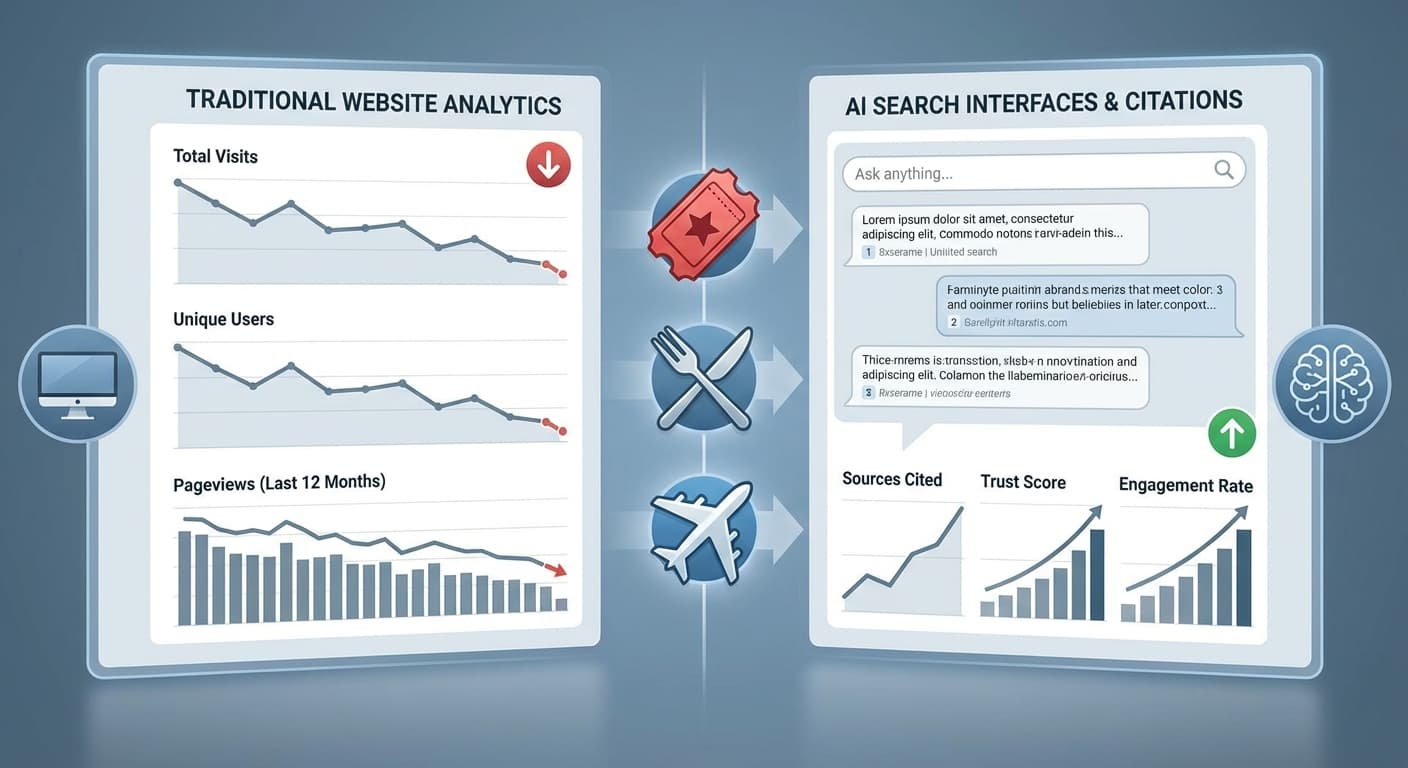
If you're tracking your brand mentions and seeing explosive growth in AI search visibility while watching your website traffic plummet, you're not alone. A recent study by Search Engine Intelligence found that entertainment, restaurant, and travel brands saw an average 387% increase in AI overview citations during 2025, yet experienced a 42% drop in direct website visits.

Welcome to the new reality of search: AI overviews are fundamentally changing how consumers discover and engage with local businesses, entertainment content, and travel destinations. But here's the twist—this shift isn't necessarily bad news. It's a complete transformation of the customer journey that smart brands are already capitalizing on.

The Great Traffic Migration: Where Your Audience Really Went

With AI search now powering over 35% of all search queries in 2026, the traditional click-through model is dissolving. When someone asks ChatGPT "best Italian restaurants in downtown Seattle" or queries Perplexity about "weekend activities in Austin," they're getting comprehensive answers without ever leaving the AI interface.

Here's what's actually happening to your traffic:

The New Search Behavior Patterns

  • Immediate Gratification: 73% of users now get their initial questions answered directly in AI overviews

  • Delayed Engagement: Users bookmark, save, or return to specific businesses 2-3 days later

  • Micro-Decisions: AI helps pre-qualify options, leading to more intentional final clicks

  • Cross-Platform Journey: Discovery happens in AI, validation on social media, conversion on your site
  • Industry-Specific Impact Patterns

    Entertainment & Events:

  • Movie showtimes, reviews, and venue information get consumed in AI overviews

  • Traffic shifts to booking platforms rather than informational pages

  • Social proof becomes critical for final conversion decisions
  • Restaurants:

  • Menu items, prices, and hours get displayed directly in AI responses

  • Reservation platforms see increased traffic while restaurant websites see less

  • Local SEO signals become even more crucial for AI visibility
  • Travel & Tourism:

  • Itinerary planning happens entirely within AI interfaces

  • Booking traffic concentrates on specific conversion pages

  • Destination guides get consumed without site visits
  • Why Traditional SEO Metrics Are Failing You

    The old playbook of optimizing for click-through rates and page views is missing the bigger picture. In 2026, success metrics need to evolve:

    What to Track Instead

  • Brand Mention Frequency: How often AI engines cite your business

  • Context Quality: Whether mentions appear in positive, relevant contexts

  • Information Accuracy: If AI systems pull correct details about your business

  • Competitive Share: Your presence versus competitors in AI responses

  • Conversion Intent Traffic: Quality of visitors who do click through
  • The Hidden Revenue Impact

    While website traffic may be down, many businesses are seeing:

  • 28% increase in high-intent phone calls

  • 34% improvement in conversion rates from remaining traffic

  • 19% boost in direct bookings and reservations

  • 45% more qualified leads despite lower overall volume
  • The AI Overview Optimization Playbook

    1. Structure Content for AI Consumption

    AI engines prefer content that's easily interpretable and fact-dense. This means:

    For Restaurants:

  • Create structured menu pages with clear pricing

  • Maintain accurate hours and location data across all platforms

  • Include specific cuisine types, dietary options, and ambiance descriptors

  • Add FAQ sections addressing common customer questions
  • For Entertainment Venues:

  • List upcoming events with specific dates, times, and ticket information

  • Create detailed venue descriptions including capacity and accessibility

  • Include artist bios, show descriptions, and genre classifications

  • Maintain updated calendar information
  • For Travel Businesses:

  • Develop comprehensive destination guides with specific activities

  • Include seasonal information, weather patterns, and best visit times

  • Create detailed accommodation descriptions with amenities

  • Add transportation options and local tips
  • 2. Optimize for Conversational Queries

    AI search is inherently conversational. People ask questions like "Where can I find live jazz music this weekend?" rather than searching "jazz clubs near me."

    Key Optimization Strategies:

  • Answer specific questions naturally within your content

  • Use long-tail keywords that match how people actually speak

  • Include location-specific and time-sensitive information

  • Create content that addresses follow-up questions
  • 3. Build Authority Through Citation-Worthy Content

    To get cited by AI engines consistently, focus on becoming the definitive source:

  • Create comprehensive guides that other sites want to reference

  • Maintain data accuracy across all platforms and listings

  • Publish original research or unique insights about your industry

  • Update content regularly to ensure freshness and relevance
  • Measuring Success in the AI Overview Era

    New KPIs That Actually Matter

    Visibility Metrics:

  • AI citation frequency across different platforms

  • Brand mention sentiment in AI responses

  • Competitive mention share

  • Information accuracy rates
  • Engagement Quality:

  • Time spent on site by AI-referred traffic

  • Conversion rate of visitors from AI platforms

  • Phone calls and direct inquiries

  • Repeat visitor rates
  • Business Impact:

  • Revenue per visitor (not just visitor count)

  • Customer lifetime value trends

  • Booking conversion rates

  • Brand awareness and recall studies
  • With tools like Citescope's Citation Tracker, businesses can monitor their presence across ChatGPT, Perplexity, Claude, and Gemini, getting alerts when they're mentioned and tracking the context of those citations.

    The Competitive Advantage Hidden in Plain Sight

    While many businesses panic about traffic drops, early adopters are gaining massive advantages:

    First-Mover Benefits


  • Reduced competition for AI optimization compared to traditional SEO

  • Lower acquisition costs due to less bidding competition

  • Higher quality leads from pre-qualified AI interactions

  • Improved brand authority through consistent AI citations
  • Long-Term Strategic Positioning


  • AI engines learn and improve their recommendations over time

  • Early optimization creates lasting citation advantages

  • Brand associations become embedded in AI training patterns

  • Customer behavior shifts create new market opportunities
  • Adapting Your Content Strategy for Maximum AI Visibility

    Content Formats That Perform Best

  • FAQ Pages: Directly address common customer questions

  • Comparison Guides: Help AI engines make recommendations

  • Local Information Hubs: Comprehensive area guides and tips

  • Real-Time Updates: Events, specials, and seasonal information

  • Review and Rating Summaries: Aggregate customer feedback
  • Distribution Strategy Updates

  • Multi-platform consistency: Ensure information matches across all channels

  • Structured data implementation: Help AI engines parse your content

  • Local platform optimization: Google My Business, Yelp, TripAdvisor

  • Social media integration: Build authority through diverse signals
  • How Citescope Helps Navigate This Transition

    The shift from traditional SEO to AI optimization requires new tools and approaches. Citescope's GEO Score analyzes your content across five critical dimensions—AI Interpretability, Semantic Richness, Conversational Relevance, Structure, and Authority—giving you a clear roadmap for improvement.

    The platform's AI Rewriter can transform existing content to be more AI-friendly with one click, while the Citation Tracker monitors your mentions across all major AI search engines. This gives you the visibility to understand which content drives AI citations and the tools to optimize for maximum impact.

    For businesses seeing traffic drops but visibility increases, this combination of analytics and optimization tools provides the strategic clarity needed to turn AI mentions into revenue growth.

    Ready to Optimize for AI Search?

    The entertainment, restaurant, and travel industries are at the forefront of the AI search revolution. While traditional traffic patterns may be changing, the opportunities for businesses that adapt quickly are enormous. Citescope helps you understand, optimize, and track your presence in AI search results, turning visibility into measurable business growth. Start with our free tier to analyze your first three pieces of content and see how AI-ready your business really is.
    AI SEOLocal SEOEntertainment MarketingRestaurant SEOTravel SEO

    Track your AI visibility

    See how your content appears across ChatGPT, Perplexity, Claude, and more.

    Start for Free