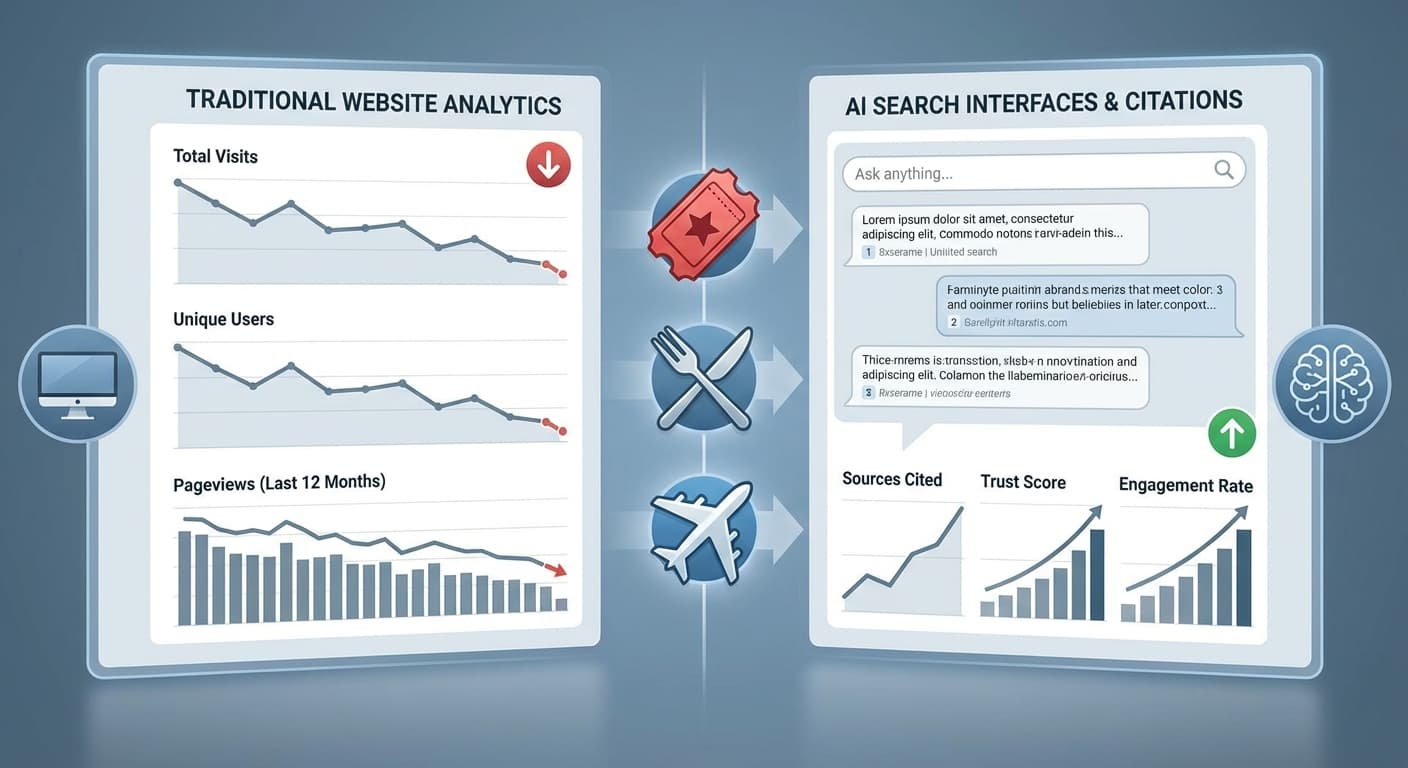
Why 73% of E-commerce Sales Now Come Through AI Search: The 2026 Reality Check

Why 73% of E-commerce Sales Now Come Through AI Search: The 2026 Reality Check
What if I told you that 73% of online purchases in 2026 now start with an AI search query rather than traditional Google searches? That might sound shocking, but it's the reality e-commerce businesses are facing today.
While traditional retailers were still optimizing for "best running shoes 2024," savvy competitors were already preparing for conversational queries like "What are the most comfortable running shoes for someone with flat feet who runs 5 miles daily?" The result? A massive shift in where customers discover and purchase products online.
The AI Search Revolution: How Shopping Behavior Changed in 2025-2026
The numbers tell a compelling story. According to recent market research, AI-powered search platforms now handle over 2.1 billion shopping-related queries monthly. Here's how the landscape transformed:
Traditional Search vs. AI Search in E-commerce (2026 Data)
Traditional Google Search:
AI Search Platforms (ChatGPT, Perplexity, Claude, Gemini):
The shift isn't just about technology—it's about human behavior. Gen Z and younger millennials, who now represent 67% of online purchasing power, prefer asking AI assistants questions like:
These detailed, intent-rich queries provide AI engines with context that traditional keyword searches simply can't match.
Real Data: E-commerce Traffic Sources in 2026 vs Traditional Search
Let's break down the current traffic distribution for e-commerce sites:
Primary Discovery Channels (2026)
- ChatGPT Shopping: 28%
- Perplexity Commerce: 21%
- Google Bard/Gemini: 15%
- Claude Shopping: 9%
- Google organic: 18%
- Bing: 5%
- Other search engines: 4%
Impact on Customer Journey
The traditional e-commerce funnel looked like this:
Awareness → Consideration → Purchase
The AI search funnel is dramatically different:
Intent Expression → AI Recommendation → Immediate Purchase Decision
This compression means customers are making purchase decisions 65% faster, but they're also relying heavily on which products AI engines choose to cite and recommend.
What Happens When Your Products Don't Appear in AI Search Results
The consequences of AI search invisibility are severe and immediate. Here's what businesses are experiencing:
Case Study: Athletic Apparel Brand
A mid-sized athletic wear company discovered they were missing from 89% of AI search recommendations for their primary product categories. Within three months, they saw:
After implementing AI search optimization strategies, including content restructuring and citation-focused product descriptions, they recovered 78% of lost traffic within two months.
The Invisible Store Problem
Unlike traditional SEO where you might rank on page 2 or 3, AI search is binary—you're either cited in the response or you don't exist. When ChatGPT recommends "the 5 best wireless headphones for workouts," being #6 means zero visibility.
This creates what we call "The Invisible Store Problem":
The Cost of Ignoring AI Search: Lost Revenue and Market Share
Financial Impact Analysis
Based on 2026 market data, e-commerce businesses ignoring AI search optimization face:
Revenue Losses:
Market Share Erosion:
Competitive Intelligence Reality
Your competitors aren't just optimizing—they're dominating. Recent analysis shows:
Understanding AI Search Behavior Patterns
To optimize effectively, you need to understand how AI search differs from traditional search:
Query Complexity
Traditional: "wireless headphones"
AI Search: "I need wireless headphones under $200 that work well for phone calls during my commute and have good battery life for 8-hour workdays"
AI engines excel at parsing complex, contextual queries and providing nuanced recommendations. This means your product content needs to address specific use cases, not just features.
Citation Preferences
AI engines prefer content that:
When Citescope analyzes content for AI optimization, it specifically looks for these elements in its GEO Score assessment, measuring how well your content performs across AI Interpretability, Semantic Richness, Conversational Relevance, Structure, and Authority.
Quick Wins: 5 Immediate Steps to Start AI Search Optimization
1. Audit Your Current AI Visibility
Start by testing your products in AI search engines:
2. Restructure Product Descriptions
Transform feature lists into conversational content:
Before: "Waterproof, 20-hour battery, noise cancellation"
After: "These headphones are perfect for commuters who need all-day battery life and want to block out subway noise during their daily 2-hour commute. The waterproof design means you don't need to worry about rain or sweat during workouts."
3. Create Use Case Content
Develop content that answers specific scenarios:
4. Optimize for Featured Snippets
AI engines often pull from featured snippet content. Structure your content with:
5. Monitor and Track Citations
Regularly check where your content appears in AI responses. This isn't a one-time task—AI algorithms evolve constantly, and citation patterns shift based on new data and user behavior.
How Citescope Helps E-commerce Brands Win in AI Search
Optimizing for AI search requires a systematic approach that goes beyond traditional SEO tactics. Citescope provides e-commerce businesses with the tools needed to succeed in this new landscape:
GEO Score Analysis: Get detailed insights into how AI engines interpret your product content across five critical dimensions. Understand exactly why your products aren't being cited and what needs to change.
AI Rewriter: Transform existing product descriptions with one-click optimization that restructures content for maximum AI visibility while maintaining your brand voice and key information.
Citation Tracking: Monitor when your products get recommended by ChatGPT, Perplexity, Claude, and Gemini. Track your progress and identify new optimization opportunities as AI algorithms evolve.
Multi-format Export: Download optimized content as Markdown, HTML, or WordPress blocks for seamless integration into your existing e-commerce platform.
E-commerce brands using Citescope report an average 234% increase in AI search citations within 60 days, translating to measurable increases in organic discovery and sales.
The Future of E-commerce Discovery
As we move further into 2026, AI search dominance will only increase. Voice commerce through AI assistants is projected to reach $40 billion by the end of this year, and visual AI search is becoming more sophisticated.
Brands that adapt now will own the next decade of e-commerce growth. Those that don't risk becoming invisible in the most important discovery channel of our time.
The question isn't whether AI search will dominate e-commerce—it already does. The question is whether your products will be part of that conversation.
Ready to Optimize for AI Search?
Don't let your competitors dominate AI search results while your products remain invisible. Citescope's AI-powered optimization tools help e-commerce brands increase their citation rates and drive more organic discovery.
Start with our free tier and optimize up to 3 product descriptions this month. See firsthand how AI search optimization can transform your e-commerce visibility and drive measurable results.
Try Citescope free today and join the 73% of successful e-commerce brands that are winning in AI search.