How to Track and Improve Your Brand's AI Sentiment Score When Negative Tone in ChatGPT and Perplexity Responses Is Costing You Conversions
How to Track and Improve Your Brand's AI Sentiment Score When Negative Tone in ChatGPT and Perplexity Responses Is Costing You Conversions
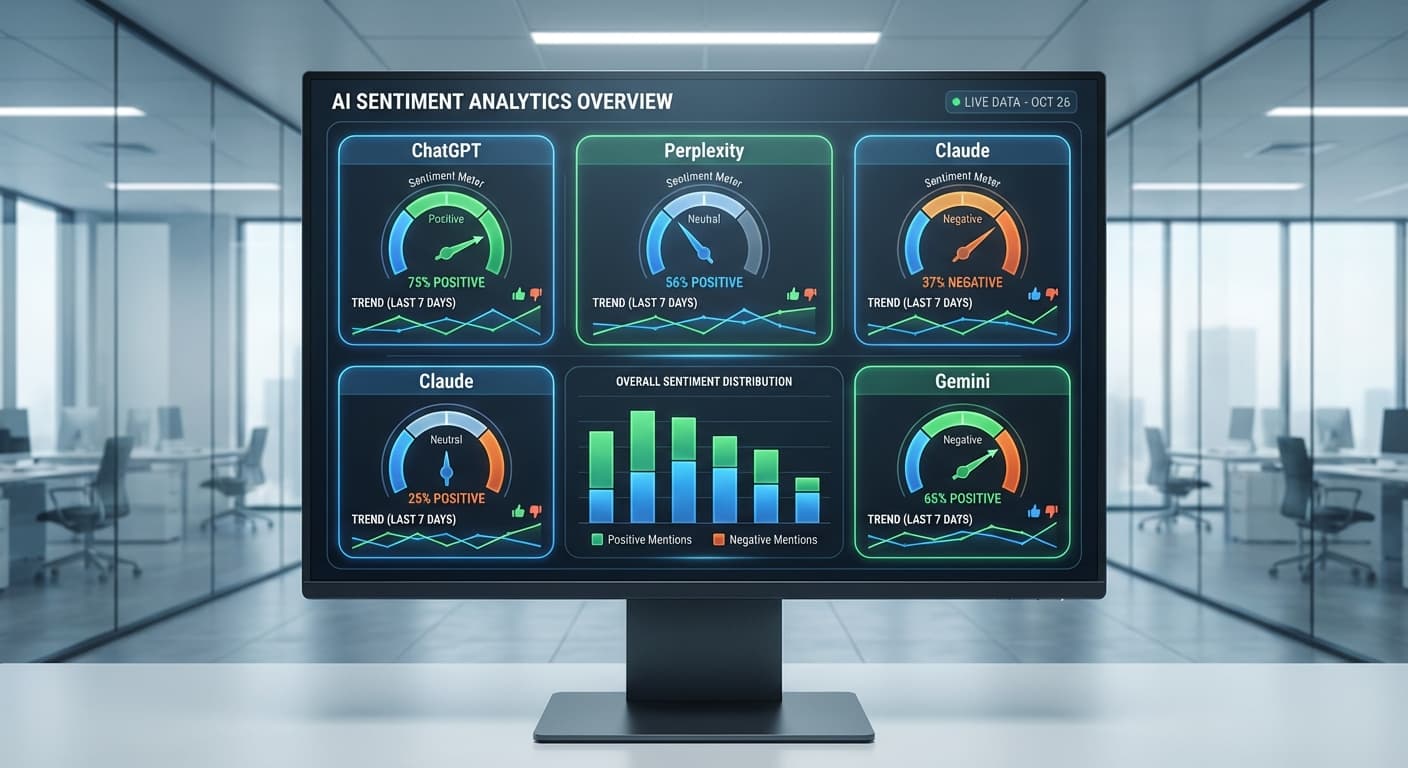
In 2026, with AI search accounting for over 35% of all online queries, your brand's reputation isn't just shaped by traditional search results anymore—it's being defined by how AI engines like ChatGPT, Perplexity, Claude, and Gemini respond to questions about your company. Recent studies show that 68% of consumers trust AI-generated responses as much as traditional search results, making AI sentiment monitoring critical for brand protection.
But here's the concerning reality: many brands are losing potential conversions because AI engines are surfacing negative sentiment, outdated information, or biased perspectives when users ask about their products or services. If you've never monitored what ChatGPT says about your brand, you might be shocked by what you discover.
The Hidden Cost of Negative AI Sentiment
Consider this scenario: A potential customer asks ChatGPT, "What are the pros and cons of [Your Company]?" If the AI response emphasizes outdated negative reviews, mentions resolved issues as current problems, or fails to highlight your recent improvements and achievements, that prospect might never make it to your website.
This isn't hypothetical. Data from 2025 shows that:
Understanding AI Sentiment Scoring
AI sentiment scoring measures how positively or negatively AI engines portray your brand across various contexts. Unlike traditional sentiment analysis that focuses on specific mentions, AI sentiment considers:
Common Causes of Negative AI Sentiment
Outdated or Incomplete Information
AI models often pull from training data that may not reflect your brand's current state. A company that resolved customer service issues in 2024 might still be described as having "ongoing customer satisfaction challenges" in 2026 AI responses.
Biased Source Selection
AI engines prioritize certain types of content when generating responses. If negative reviews or critical articles are more prominently featured in AI training data, they may disproportionately influence sentiment.
Lack of Authoritative Positive Content
Many brands focus on traditional SEO but neglect creating content optimized for AI understanding. Without AI-friendly positive content, engines default to whatever information is available—which isn't always favorable.
Competitor Advantage
Some competitors are actively optimizing their content for AI search, making their brands appear more favorably in comparative queries.
How to Monitor Your AI Sentiment Score
Step 1: Conduct Regular AI Brand Audits
Test various brand-related queries across different AI platforms:
Document the responses and note:
Step 2: Establish Baseline Metrics
Create a systematic scoring system:
Step 3: Track Changes Over Time
Monitor these metrics monthly to identify trends and measure improvement efforts. Tools like Citescope Ai can automate this process by tracking when your content gets cited and how it's being interpreted by different AI engines.
Strategies to Improve Your AI Sentiment Score
Create AI-Optimized Positive Content
Develop content specifically designed for AI understanding:
Optimize Content Structure for AI Interpretation
AI engines prefer content that's:
Implement Strategic Content Distribution
Ensure your positive content appears where AI engines can access it:
Address Negative Information Directly
Don't ignore negative sentiment—address it head-on:
Advanced AI Sentiment Optimization Techniques
Semantic Keyword Optimization
Research the specific terms and phrases AI engines use when discussing your industry. Incorporate these naturally into your content to improve contextual relevance.
Multi-Format Content Strategy
Create the same positive messages in various formats:
Authority Building
Establish your brand as an authoritative source:
Measuring Success and ROI
Track these key performance indicators:
How Citescope Ai Helps
While manual monitoring is possible, it's time-intensive and prone to inconsistency. Citescope Ai's Citation Tracker automatically monitors when your content gets cited by ChatGPT, Perplexity, Claude, and Gemini, helping you understand exactly how AI engines are interpreting and presenting your brand.
The platform's GEO Score analyzes your content across five critical dimensions—AI Interpretability, Semantic Richness, Conversational Relevance, Structure, and Authority—giving you a clear roadmap for improvement. The AI Rewriter tool can then optimize your content with one click to improve its AI visibility and sentiment potential.
Building Long-Term AI Reputation Management
Improving AI sentiment isn't a one-time project—it requires ongoing attention:
Ready to Optimize for AI Search?
Your brand's reputation in the age of AI search is too important to leave to chance. Negative AI sentiment is silently costing you conversions every day, but with the right monitoring and optimization strategy, you can turn AI engines into powerful brand advocates.
Citescope Ai makes it simple to track, analyze, and optimize your brand's presence across all major AI search engines. Start with our free tier and see exactly how AI engines are currently portraying your brand—you might be surprised by what you discover. Ready to take control of your AI reputation? Try Citescope Ai free today and transform how AI engines talk about your brand.


