GEO Strategy

How to Structure Your Business Website to Be Discoverable by Autonomous AI Shopping Agents When Agentic Commerce Skips Your Site Entirely
February 2, 20266 min read
How to Structure Your Business Website to Be Discoverable by Autonomous AI Shopping Agents When Agentic Commerce Skips Your Site Entirely

How to Structure Your Business Website to Be Discoverable by Autonomous AI Shopping Agents When Agentic Commerce Skips Your Site Entirely

By 2026, over 40% of online purchases are initiated by AI agents acting on behalf of consumers. These autonomous shopping assistants—from ChatGPT's shopping features to Google's Bard Commerce and emerging platforms like Perplexity Shopping—are fundamentally changing how businesses need to structure their websites. The challenge? Many of these AI agents bypass traditional website browsing entirely, extracting product information directly from structured data and content snippets.

If your business website isn't optimized for AI agent discovery, you're essentially invisible in the fastest-growing segment of e-commerce.

The Rise of Agentic Commerce in 2026

Agentic commerce represents a seismic shift in online shopping behavior. Unlike traditional search where users browse multiple websites, AI shopping agents aggregate information, compare options, and make recommendations without users ever visiting your site directly.

Key statistics driving this transformation:

  • 65% of Gen Z consumers now use AI assistants for product research and purchases

  • AI-driven e-commerce transactions grew 340% year-over-year in 2025

  • 78% of businesses report losing sales to competitors better optimized for AI discovery

  • Average cart values through AI agents are 23% higher than traditional browsing
  • The implications are clear: businesses that fail to optimize for AI agent discovery risk being completely bypassed in the purchase journey.

    How AI Shopping Agents Actually Work

    To structure your website effectively, you need to understand how these agents operate:

    Information Extraction Process

  • Crawling and Indexing: AI agents continuously scan websites for product information

  • Data Synthesis: They extract key details like pricing, features, availability, and reviews

  • Comparison Analysis: Agents compare similar products across multiple sources

  • Recommendation Generation: They provide curated suggestions based on user preferences

  • Transaction Facilitation: Some agents can complete purchases directly
  • What AI Agents Look For

    AI shopping agents prioritize websites that provide:

  • Clear product specifications in structured formats

  • Comprehensive pricing information including promotions and shipping

  • Authentic customer reviews and ratings

  • Real-time inventory status

  • Detailed product descriptions optimized for natural language processing
  • Essential Website Structure Elements for AI Discovery

    1. Implement Advanced Schema Markup

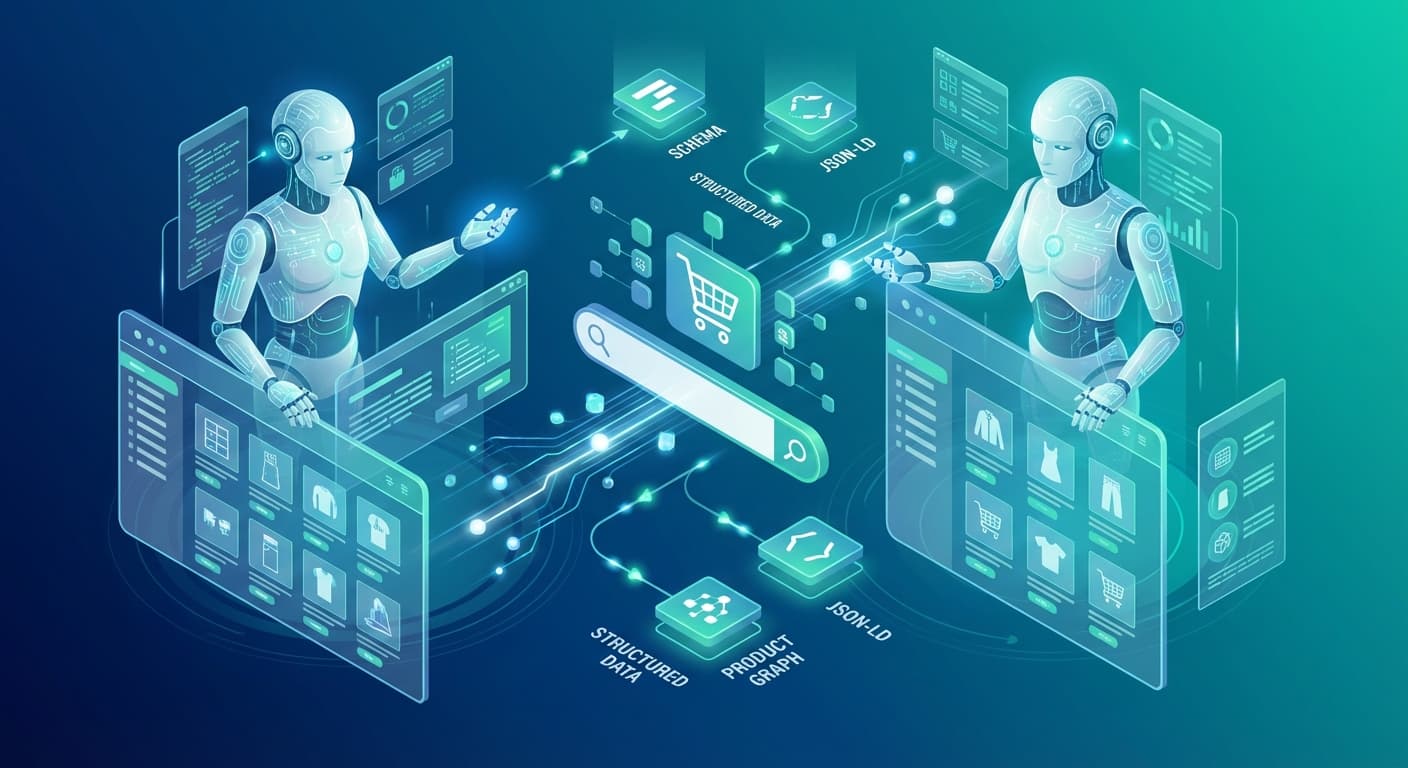
    Schema markup is your direct communication channel with AI agents. Beyond basic product schema, implement:

    Product Schema Essentials:

  • Product name, brand, and model

  • Detailed descriptions and specifications

  • Pricing and currency information

  • Availability and inventory status

  • Customer ratings and review counts

  • Images with alt text descriptions
  • Enhanced Schema Types:

  • FAQPage schema for common product questions

  • Organization schema for business credibility

  • BreadcrumbList for navigation context

  • Review and AggregateRating schemas
  • 2. Create AI-Friendly Content Architecture

    Product Information Hierarchy:

    ├── Product Title (H1)
    ├── Key Features (H2)
    │ ├── Specifications (H3)
    │ └── Use Cases (H3)
    ├── Pricing & Availability (H2)
    ├── Customer Reviews (H2)
    └── Related Products (H2)


    Content Optimization Guidelines:

  • Use clear, descriptive headings that answer specific questions

  • Include bullet points for easy scanning

  • Provide comparison tables when relevant

  • Write in natural, conversational language

  • Answer common "why," "how," and "what" questions
  • 3. Optimize for Voice and Conversational Queries

    AI agents often process natural language queries. Structure content to answer questions like:

  • "What's the best [product] for [specific use case]?"

  • "How does [your product] compare to [competitor]?"

  • "Is [product] available in [location/color/size]?"

  • "What do customers say about [product feature]?"
  • 4. Implement Dynamic Inventory Management

    AI agents value real-time information. Ensure your website provides:

  • Live inventory status ("In Stock," "Limited Quantity," "Backorder")

  • Shipping timeframes and costs

  • Regional availability information

  • Price changes and promotional updates
  • Technical Implementation Strategies

    JSON-LD Structured Data

    Implement comprehensive JSON-LD markup for each product page:


    {
    "@context": "https://schema.org/",
    "@type": "Product",
    "name": "Product Name",
    "description": "Detailed product description",
    "brand": {
    "@type": "Brand",
    "name": "Brand Name"
    },
    "offers": {
    "@type": "Offer",
    "price": "99.99",
    "priceCurrency": "USD",
    "availability": "https://schema.org/InStock"
    }
    }


    API-First Content Management

    Consider implementing headless CMS solutions that can:

  • Serve content to both human users and AI agents

  • Provide structured data feeds

  • Enable real-time updates across platforms

  • Support multiple content formats simultaneously
  • Site Performance Optimization

    AI agents favor fast-loading, accessible websites:

  • Core Web Vitals optimization

  • Mobile-first responsive design

  • Structured navigation with clear hierarchies

  • Fast server response times (under 200ms)
  • Content Strategy for AI Agent Visibility

    FAQ-Driven Content Creation

    Develop comprehensive FAQ sections that address:

  • Product specifications and features

  • Compatibility and usage scenarios

  • Pricing and shipping information

  • Return and warranty policies

  • Customer support processes
  • Comparison Content

    Create detailed comparison pages that help AI agents understand your competitive positioning:

  • Feature-by-feature comparisons

  • Price comparison tables

  • Use case recommendations

  • Pros and cons analysis
  • User-Generated Content Integration

    Leverage customer reviews, Q&As, and testimonials:

  • Implement review schema markup

  • Encourage detailed, specific reviews

  • Create Q&A sections for common questions

  • Showcase customer photos and videos
  • Monitoring and Measuring AI Discovery

    Track your website's performance in AI-driven commerce:

    Key Metrics to Monitor


  • AI agent traffic and engagement patterns

  • Structured data validation and coverage

  • Featured snippet and AI citation appearances

  • Voice search ranking performance

  • Conversion rates from AI-referred traffic
  • Tools for Measurement


  • Google Search Console for structured data monitoring

  • AI-specific analytics platforms

  • Citation tracking tools for AI mentions

  • Customer journey analysis focusing on AI touchpoints
  • How Citescope Ai Helps

    Optimizing your website for AI shopping agents requires continuous monitoring and refinement. Citescope Ai's comprehensive platform helps businesses track and improve their AI visibility across shopping contexts:

  • GEO Score Analysis: Evaluate your product pages across the five key dimensions that AI agents prioritize

  • Citation Tracking: Monitor when AI shopping assistants mention or recommend your products

  • Content Optimization: Use the AI Rewriter to restructure product descriptions for better agent comprehension

  • Multi-format Export: Deploy optimized content across different platforms and formats
  • With Citescope Ai, you can ensure your business remains discoverable as agentic commerce continues to reshape online shopping.

    Future-Proofing Your E-commerce Strategy

    As AI shopping agents become more sophisticated, businesses must:

    Embrace Omnichannel AI Optimization


  • Optimize for multiple AI platforms simultaneously

  • Maintain consistent product information across channels

  • Develop platform-specific content strategies
  • Invest in Customer Experience


  • Focus on authentic reviews and ratings

  • Provide comprehensive customer support

  • Maintain transparent pricing and policies
  • Stay Agile and Adaptive


  • Monitor AI agent behavior changes

  • Update structured data as standards evolve

  • Test and iterate content optimization strategies
  • Ready to Optimize for AI Search?

    Don't let AI shopping agents bypass your business. With agentic commerce rapidly transforming online shopping, the time to optimize is now. Citescope Ai provides the tools and insights you need to structure your website for maximum AI agent discovery and customer reach. Start with our free tier to analyze your current AI visibility and see how small changes can drive significant results in the age of autonomous commerce.

    Start optimizing your website for AI agents with Citescope Ai's free analysis tool today.
    agentic commerceAI shopping agentse-commerce optimizationstructured dataAI visibility

    Track your AI visibility

    See how your content appears across ChatGPT, Perplexity, Claude, and more.

    Start for Free