How to Structure Content for Dual-Audience Optimization: AI Agents vs. Human Readers
How to Structure Content for Dual-Audience Optimization: AI Agents vs. Human Readers
By 2026, content creators face an unprecedented challenge: writing for two completely different audiences simultaneously. While 73% of Gen Z now uses AI search engines as their primary research tool, human readers still drive engagement and conversions on your website. The problem? AI agents and human readers interpret content signals in fundamentally different ways.
The Dual-Audience Reality
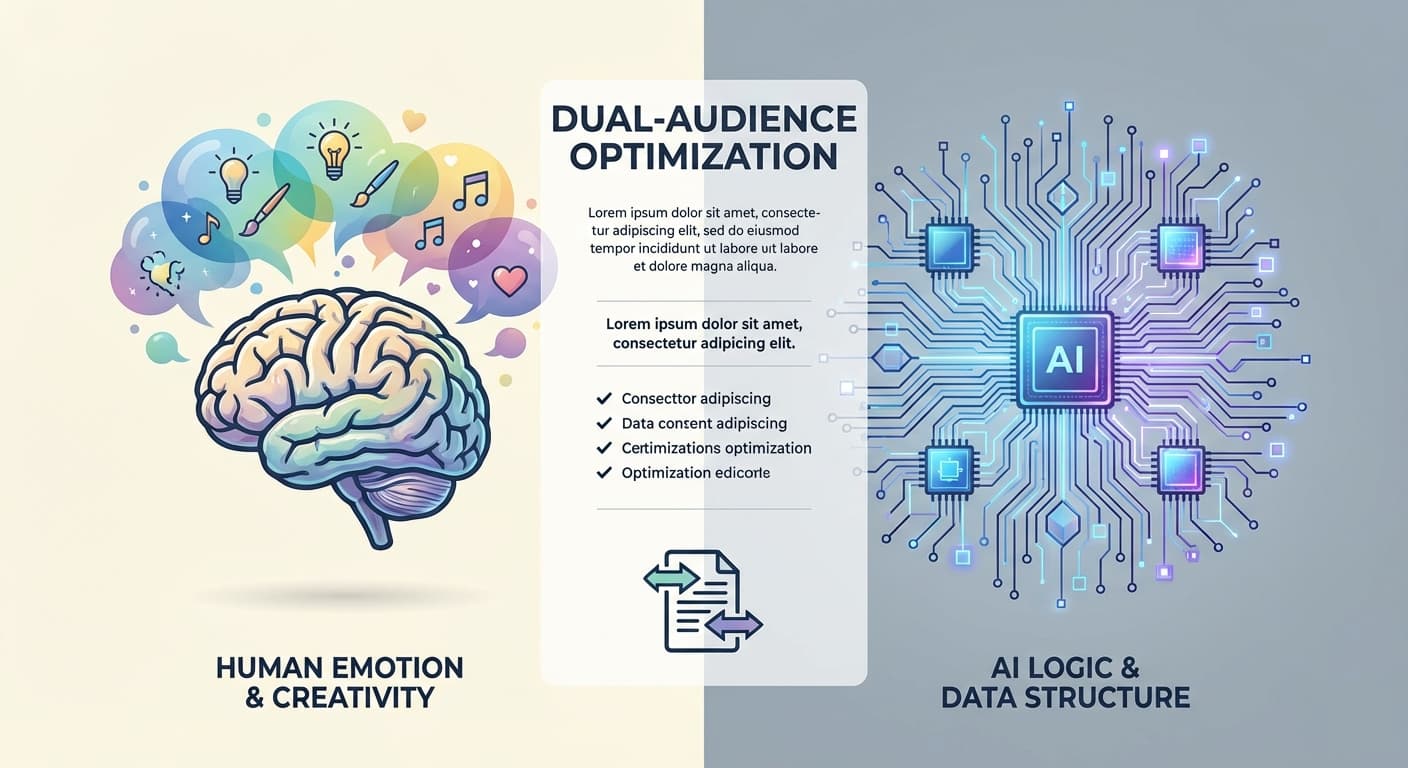
AI search engines like ChatGPT, Perplexity, and Claude now handle over 40% of all search queries, but they "read" content differently than humans do. AI agents prioritize semantic clarity, structured data, and contextual relationships, while human readers gravitate toward emotional hooks, storytelling, and visual breaks.
This creates a tension: optimizing purely for AI can make content feel robotic to humans, while human-focused content might be invisible to AI agents.
Understanding the Fundamental Differences
How AI Agents Process Content
AI agents scan content for specific signals:
How Human Readers Engage
Human readers respond to different elements:
The Dual-Optimization Framework
1. Create a Hierarchical Information Architecture
Structure your content with both audiences in mind:
For AI Agents:
For Human Readers:
2. Master the Art of Dual-Layer Writing
Each paragraph should serve both audiences:
Opening sentences should be factual and keyword-rich for AI agents, while supporting sentences add context, emotion, and relatability for humans.
Example:
> "Content marketing ROI increased by 67% for companies using AI-optimized structures in 2025." (AI-focused fact)
> "If you've been struggling to get your content noticed in an increasingly crowded digital landscape, this statistic represents a game-changing opportunity you can't afford to ignore." (Human-focused emotion)
3. Implement Strategic Keyword Integration
For AI Visibility:
For Human Readability:
Advanced Dual-Optimization Techniques
Schema Markup and Structured Data
While invisible to human readers, structured data significantly improves AI comprehension:
Content Depth Balancing
AI agents prefer comprehensive coverage, while humans want concise value. Solve this with:
Internal Linking Strategy
For AI Agents:
For Human Readers:
Content Format Optimization
The Question-Answer Structure
This format naturally serves both audiences:
Table and List Integration
Structured formats benefit both audiences:
Tables:
Lists:
Measuring Dual-Audience Success
AI Performance Metrics
Human Engagement Metrics
Common Dual-Optimization Mistakes
Over-Optimization for AI
Under-Optimization for AI
Inconsistent Voice
How Citescope Ai Helps
Dual-audience optimization requires sophisticated analysis that manual efforts can't match. Citescope Ai's GEO Score analyzes your content across five critical dimensions - AI Interpretability, Semantic Richness, Conversational Relevance, Structure, and Authority - giving you a comprehensive 0-100 score that shows exactly how well you're serving both audiences.
The platform's AI Rewriter uses advanced algorithms to restructure your content for maximum AI visibility while preserving the human engagement elements that drive conversions. Instead of choosing between AI optimization and human appeal, you can achieve both with one-click optimization.
The Citation Tracker then monitors your success, showing when your dual-optimized content gets cited by ChatGPT, Perplexity, Claude, and Gemini, while your human engagement metrics track improvements in user behavior.
Future-Proofing Your Dual-Audience Strategy
As AI capabilities evolve and human attention spans shift, dual-audience optimization will become even more critical. The companies that master this balance now will dominate both AI citations and human engagement in the years ahead.
Key trends to watch:
Ready to Optimize for AI Search?
Dual-audience optimization doesn't have to be overwhelming. Citescope Ai takes the guesswork out of balancing AI visibility with human engagement, giving you the tools and insights to succeed with both audiences. Start your free trial today and see how your content performs across all five optimization dimensions. With three free optimizations per month, you can test the platform's capabilities and watch your content citations grow while maintaining the human connection that drives your business forward.


