Industry News

How to Optimize Your Content for SearchGPT vs Google AI Overviews: Platform-Specific Strategies for 2025
January 22, 20268 min read
How to Optimize Your Content for SearchGPT vs Google AI Overviews: Platform-Specific Strategies for 2025

How to Optimize Your Content for SearchGPT vs Google AI Overviews: Platform-Specific Strategies for 2025

By 2026, AI-powered search has fundamentally transformed how people discover information online. With AI search now accounting for over 30% of all queries and SearchGPT processing millions of searches daily alongside Google's AI Overviews reaching 85% of search results, content creators face a critical question: How do you optimize for these different AI systems when they operate so differently?

The answer isn't one-size-fits-all. SearchGPT and Google AI Overviews have distinct algorithms, preferences, and user interfaces that require tailored optimization strategies. Getting this right could mean the difference between your content being featured prominently or buried in obscurity.

The Tale of Two AI Systems: Understanding the Key Differences

Before diving into optimization strategies, it's crucial to understand how SearchGPT and Google AI Overviews fundamentally differ in their approach to content.

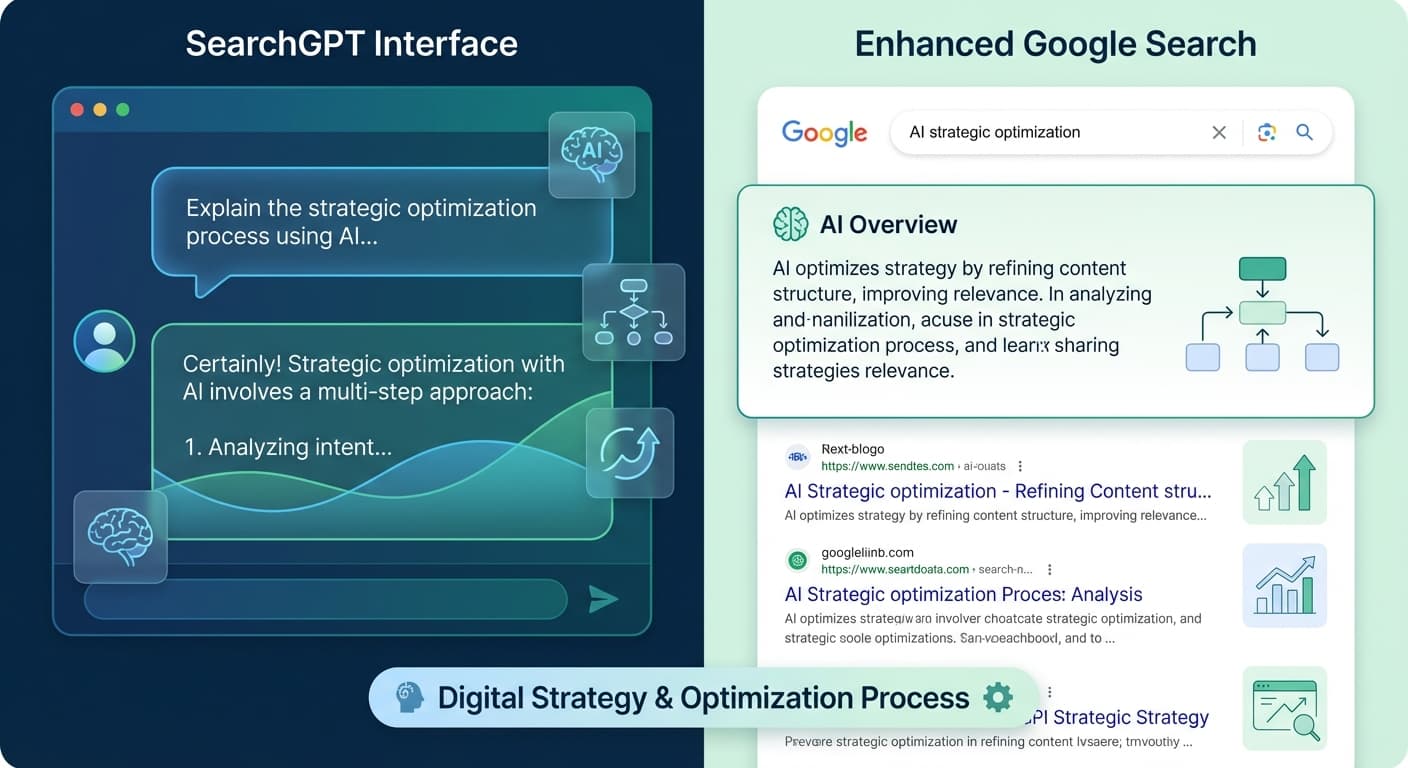
SearchGPT: The Conversational Search Engine

SearchGPT operates more like an AI research assistant than a traditional search engine. It:

  • Prioritizes comprehensive, well-structured content that can answer follow-up questions

  • Values semantic relationships and contextual depth

  • Prefers content that reads naturally in conversational formats

  • Heavily weighs recent, authoritative sources with clear attribution

  • Focuses on providing complete answers rather than driving traffic to source sites
  • Google AI Overviews: The Enhanced Traditional Search

    Google AI Overviews, while AI-powered, still operate within Google's traditional search framework:

  • Maintains strong emphasis on domain authority and backlink profiles

  • Continues to prioritize page experience signals and technical SEO

  • Favors content that aligns with user intent and search history

  • Values structured data and schema markup heavily

  • Balances AI-generated summaries with driving traffic to source websites
  • SearchGPT Optimization Strategies: Writing for AI Comprehension

    1. Structure Content for AI Interpretability

    SearchGPT excels at parsing well-organized content. Here's how to structure your content for maximum AI visibility:

    Use Clear Hierarchical Headings

  • Implement a logical H2 → H3 → H4 structure

  • Include your target keywords naturally in headings

  • Make each section capable of standing alone as a complete thought
  • Create Comprehensive Topic Clusters

  • Cover topics exhaustively within single pieces

  • Include related subtopics and common questions

  • Link concepts together with clear transitional phrases
  • 2. Optimize for Semantic Richness

    SearchGPT understands context and relationships between concepts better than traditional search engines.

    Implement Entity-Based Writing

  • Define key terms and concepts clearly

  • Use synonyms and related terminology throughout

  • Connect ideas with explicit relationship statements ("This leads to...", "As a result...", "In contrast...")
  • Answer the "Why" Behind Every "What"

  • Provide reasoning and context for all claims

  • Include cause-and-effect relationships

  • Offer multiple perspectives on complex topics
  • 3. Write Conversationally

    Since SearchGPT often presents information in a conversational format, content that naturally flows in dialogue performs better.

  • Use second-person pronouns ("you," "your")

  • Include rhetorical questions to guide reader thinking

  • Write as if explaining to a colleague rather than lecturing

  • Break up dense information with analogies and examples
  • Google AI Overviews Optimization: Balancing AI with Traditional SEO

    1. Maintain Strong Technical SEO Foundations

    While Google's AI Overviews are sophisticated, they still rely on Google's core ranking factors.

    Optimize Page Experience Signals

  • Ensure Core Web Vitals meet Google's standards

  • Implement proper mobile responsiveness

  • Optimize for fast loading speeds (aim for under 2 seconds)
  • Leverage Structured Data

  • Use Schema.org markup for key content elements

  • Implement FAQ, How-To, and Article schema where appropriate

  • Ensure structured data validation through Google's testing tools
  • 2. Target Featured Snippet Optimization

    Google AI Overviews often pull from content that would traditionally appear in featured snippets.

    Create Snippet-Worthy Answers

  • Answer questions directly within 40-60 words

  • Use numbered lists for process explanations

  • Format comparisons in clear table structures

  • Include definitive statements that can stand alone
  • Optimize for "People Also Ask" Questions

  • Research related questions using tools like AnswerThePublic

  • Create dedicated sections answering common follow-up questions

  • Use natural language that matches how people actually ask questions
  • 3. Build Authority Through Strategic Content Depth

    Google AI Overviews favor content from authoritative sources, but authority in 2026 goes beyond just backlinks.

    Demonstrate Expertise Through Comprehensive Coverage

  • Include original research, data, or insights

  • Cite authoritative sources and link to primary research

  • Update content regularly to maintain freshness

  • Cover topics from multiple angles and use cases
  • Platform-Specific Content Formatting Techniques

    For SearchGPT Success

    Use the "Answer-Explain-Example" Format

  • Provide a direct answer to the main question

  • Explain the reasoning or methodology behind the answer

  • Include a concrete example or case study

  • Address potential counterarguments or exceptions
  • Create "Reference-Ready" Content

  • Write sections that can be easily quoted or referenced

  • Include statistics with clear source attribution

  • Use bullet points for easy scanning and extraction

  • Provide context that makes standalone quotes meaningful
  • For Google AI Overviews Success

    Optimize for Intent Matching

  • Research the specific questions your target keywords trigger

  • Analyze existing AI Overview results for your topics

  • Create content that directly addresses the user's underlying need

  • Include related subtopics that Google might want to surface
  • Balance Depth with Accessibility

  • Start with concise, overview-style introductions

  • Expand into detailed explanations for those who want more

  • Use clear topic transitions that help Google understand content structure

  • Include summary sections that can serve as AI Overview source material
  • Advanced Optimization: Understanding AI Citation Preferences

    Both SearchGPT and Google AI Overviews are more likely to cite content that demonstrates certain qualities:

    Authority Signals Both Systems Value


  • Recency: Content published or updated within the last 6 months

  • Accuracy: Factual information that aligns with authoritative sources

  • Completeness: Comprehensive coverage that doesn't leave obvious gaps

  • Attribution: Clear sourcing and citation of claims and statistics
  • Platform-Specific Citation Triggers

    SearchGPT Prefers:

  • Content with clear methodology explanations

  • Sources that provide context for their claims

  • Information that can support follow-up conversations
  • Google AI Overviews Prefer:

  • Content from domains with strong topical authority

  • Information that matches user search patterns

  • Sources with strong user engagement signals
  • Many content creators are already seeing success by using tools like Citescope to analyze their content across these different AI interpretability dimensions, helping them understand exactly what elements make their content more likely to be cited by different AI systems.

    Measuring Success: KPIs for AI Search Optimization

    Optimizing for AI search requires different success metrics than traditional SEO:

    SearchGPT Success Metrics


  • Citation Frequency: How often your content appears in SearchGPT responses

  • Context Quality: Whether citations include meaningful context from your content

  • Follow-up Mentions: When SearchGPT references your content in continuing conversations
  • Google AI Overviews Success Metrics


  • Featured Snippet Captures: Traditional featured snippets often become AI Overview sources

  • Click-through Rates: How often users click through from AI Overviews to your content

  • Impression Share: Your content's visibility in AI-enhanced search results
  • How Citescope Helps Navigate Multi-Platform AI Optimization

    Managing optimization for multiple AI platforms simultaneously can be overwhelming. This is where specialized tools become invaluable.

    Citescope's GEO Score analyzes your content across five critical dimensions that matter to both SearchGPT and Google AI Overviews:

  • AI Interpretability: How easily AI systems can parse and understand your content

  • Semantic Richness: The depth of topical coverage and entity relationships

  • Conversational Relevance: How naturally your content flows in AI-generated responses

  • Structure: The logical organization that AI systems prefer

  • Authority: The credibility signals that influence citation decisions
  • The platform's AI Rewriter then optimizes your content specifically for better AI visibility, while the Citation Tracker monitors when your content gets cited across ChatGPT, Perplexity, Claude, and Gemini – giving you real-time feedback on your optimization efforts.

    The Future of Multi-Platform AI Optimization

    As we move deeper into 2026, the divergence between different AI search systems is likely to increase rather than decrease. SearchGPT continues evolving toward more sophisticated conversational search, while Google AI Overviews are integrating more deeply with Google's broader ecosystem of services.

    Successful content creators will be those who can adapt their optimization strategies to each platform's unique characteristics while maintaining the core principles of helpful, accurate, and well-structured content.

    The key is to start now. Every piece of content you optimize today for these emerging AI search patterns positions you better for tomorrow's even more sophisticated AI systems.

    Ready to Optimize for AI Search?

    Navigating the complex landscape of AI search optimization doesn't have to be overwhelming. Citescope provides the tools and insights you need to optimize your content for both SearchGPT and Google AI Overviews simultaneously.

    Start with our free tier to analyze up to 3 pieces of content per month, or upgrade to Pro for unlimited optimizations and advanced citation tracking. See how your content performs across different AI systems and get actionable recommendations for improvement.

    Try Citescope free today and start optimizing your content for the future of search.
    AI SearchSearchGPTGoogle AI OverviewsContent OptimizationSEO 2025

    Track your AI visibility

    See how your content appears across ChatGPT, Perplexity, Claude, and more.

    Start for Free