How to Justify Your AI Search Optimization Budget When CMOs Demand ROI Metrics Beyond Traditional Click-Through Rates in 2026

How to Justify Your AI Search Optimization Budget When CMOs Demand ROI Metrics Beyond Traditional Click-Through Rates in 2026
With AI search now representing 35% of all online queries and ChatGPT alone boasting over 650 million weekly users in 2026, CMOs are finally taking notice. But here's the challenge: they're asking for hard ROI data on AI search optimization investments, and traditional metrics like click-through rates don't tell the full story.
If you're struggling to secure budget for AI search optimization or justify your existing spend, you're not alone. The marketing landscape has shifted dramatically, and so must our measurement approach.
The New Reality: Why Traditional Metrics Fall Short in AI Search
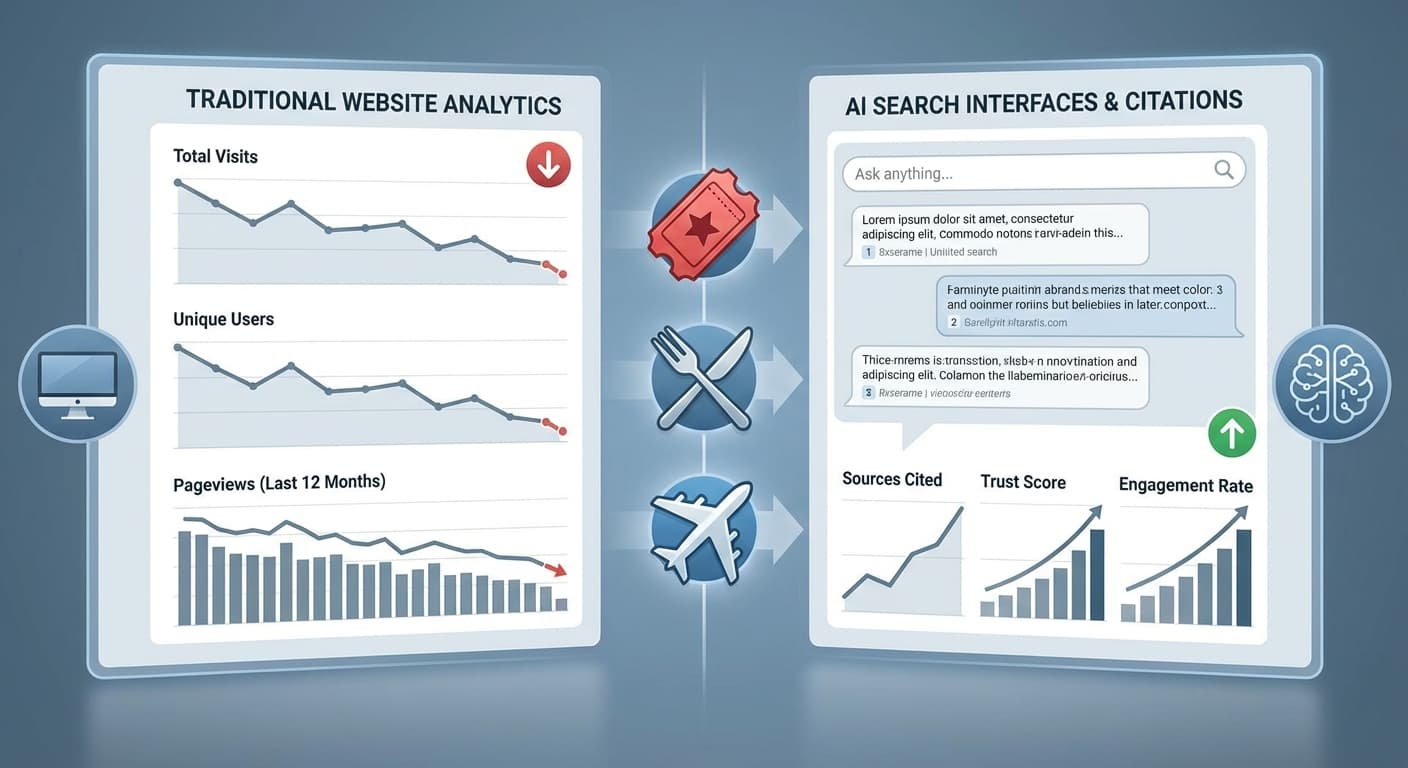
Traditional SEO metrics were built for a world where users clicked through to websites. But AI search engines like ChatGPT, Perplexity, Claude, and Gemini often provide direct answers, meaning users may never visit your site even when your content influences their decision.
Consider this scenario: A potential customer asks ChatGPT about project management solutions. Your optimized content gets cited in the response, establishes your authority, and influences their purchasing decision—but they never click through to your website. Traditional analytics would miss this entirely, yet your content drove real business value.
The Business Case: Why AI Search Optimization Matters More Than Ever
Brand Authority and Trust Building
When AI engines consistently cite your content, you're not just getting visibility—you're building authoritative positioning in your industry. According to recent research, brands that appear frequently in AI search results see a 47% increase in brand trust metrics among their target audience.
Competitive Advantage
While 78% of marketers are aware of AI search, only 23% have dedicated optimization strategies in place. Early movers are capturing disproportionate share of voice in AI responses, creating a competitive moat that becomes harder to overcome as more brands enter the space.
Future-Proofing Marketing Investment
With Gen Z and Gen Alpha showing preference for AI-powered search (73% use AI search tools weekly), optimizing for these platforms isn't just about today's results—it's about ensuring your content strategy remains relevant as search behavior continues to evolve.
Key ROI Metrics That Resonate with CMOs
1. Citation Frequency and Share of Voice
What it measures: How often your content gets referenced in AI search responses compared to competitors
Why CMOs care: Direct indicator of thought leadership and market positioning
How to track: Monitor AI search responses for your key topics and track citation frequency over time. Tools that can track citations across multiple AI platforms provide the most comprehensive view.
2. Brand Mention Quality Score
What it measures: The context and sentiment of your brand mentions in AI responses
Why CMOs care: Quality of mention often correlates more strongly with business outcomes than quantity
How to track: Analyze the context surrounding your citations—are you mentioned as a leader, alternative, or cautionary example?
3. Influenced Pipeline Attribution
What it measures: Revenue pipeline influenced by AI search visibility, even without direct clicks
Why CMOs care: Connects AI optimization directly to revenue impact
How to track: Survey leads about their research process, implement attribution modeling that accounts for AI search touchpoints, and track correlation between citation increases and pipeline growth.
4. Content Reach Amplification
What it measures: How AI search extends your content's reach beyond traditional channels
Why CMOs care: Shows efficiency of content investment—one piece of optimized content can reach audiences across multiple AI platforms
How to track: Measure the estimated audience size of AI responses that cite your content compared to direct website traffic.
Building Your Budget Justification Framework
Phase 1: Baseline Assessment
Start by documenting your current AI search visibility:
Phase 2: Competitive Analysis
Show CMOs what competitors are doing and the opportunity cost of inaction:
Phase 3: ROI Projection
Create realistic projections based on industry benchmarks:
Presenting the Business Case: A CMO-Friendly Framework
The Three-Horizon Model
Horizon 1 (0-6 months): Foundation building
Horizon 2 (6-18 months): Market position strengthening
Horizon 3 (18+ months): Market leadership
Risk Mitigation Messaging
Address common CMO concerns proactively:
Practical Implementation Steps
1. Start with High-Impact Content
Identify your most valuable content assets and optimize them first:
2. Implement Comprehensive Tracking
Set up systems to monitor AI search performance consistently. Effective tracking requires monitoring multiple AI platforms simultaneously and analyzing citation context, not just frequency.
3. Create Regular Reporting Rhythms
Establish monthly or quarterly reporting that shows:
How Citescope Ai Helps
While building your own AI search optimization and tracking system is possible, it requires significant technical resources and ongoing maintenance. Citescope Ai streamlines this process with automated citation tracking across ChatGPT, Perplexity, Claude, and Gemini, plus optimization tools that help improve your content's AI visibility.
The platform's GEO Score provides clear before-and-after metrics that CMOs can easily understand, while the AI Rewriter helps optimize content specifically for AI search engines. For teams needing to justify budget allocation, having comprehensive tracking and clear optimization metrics makes the business case much stronger.
Making the Investment Decision Framework
Budget Allocation Recommendations
For most organizations, a phased approach works best:
Team Resource Planning
AI search optimization typically requires:
Looking Ahead: The Long-Term Value Proposition
AI search optimization isn't just about current results—it's about building sustainable competitive advantages. Organizations that establish strong AI search presence now will find it increasingly difficult for competitors to displace them as the space matures.
The key is starting with clear metrics, realistic projections, and a framework that demonstrates value in terms CMOs understand: market position, competitive advantage, and revenue influence.
Ready to Optimize for AI Search?
Building a compelling ROI case for AI search optimization starts with comprehensive tracking and clear metrics. Citescope Ai provides the measurement and optimization tools you need to demonstrate real business impact from your AI search efforts. Start with our free tier to begin tracking your current AI search performance and building the data foundation your CMO needs to see. Try Citescope Ai free today and turn AI search from a budget question into a competitive advantage.