How to Build an AI Search Token Window Prioritization Strategy When Context Length Limitations Force LLMs to Truncate 40% of Long-Form Content Before Citation Evaluation
How to Build an AI Search Token Window Prioritization Strategy When Context Length Limitations Force LLMs to Truncate 40% of Long-Form Content Before Citation Evaluation
With AI search queries now representing over 35% of all search traffic in 2026, content creators face a critical challenge that most don't even know exists: AI language models are only reading about 60% of your long-form content before deciding whether to cite it.
Recent analysis of AI search behavior reveals that when processing content longer than 8,000 words, models like ChatGPT, Claude, and Perplexity often truncate substantial portions due to token window limitations. This means your most valuable insights—buried in the middle or end of comprehensive articles—may never reach the citation evaluation process.
The Hidden Problem with AI Content Processing
Large language models operate within strict token limits that vary by platform:
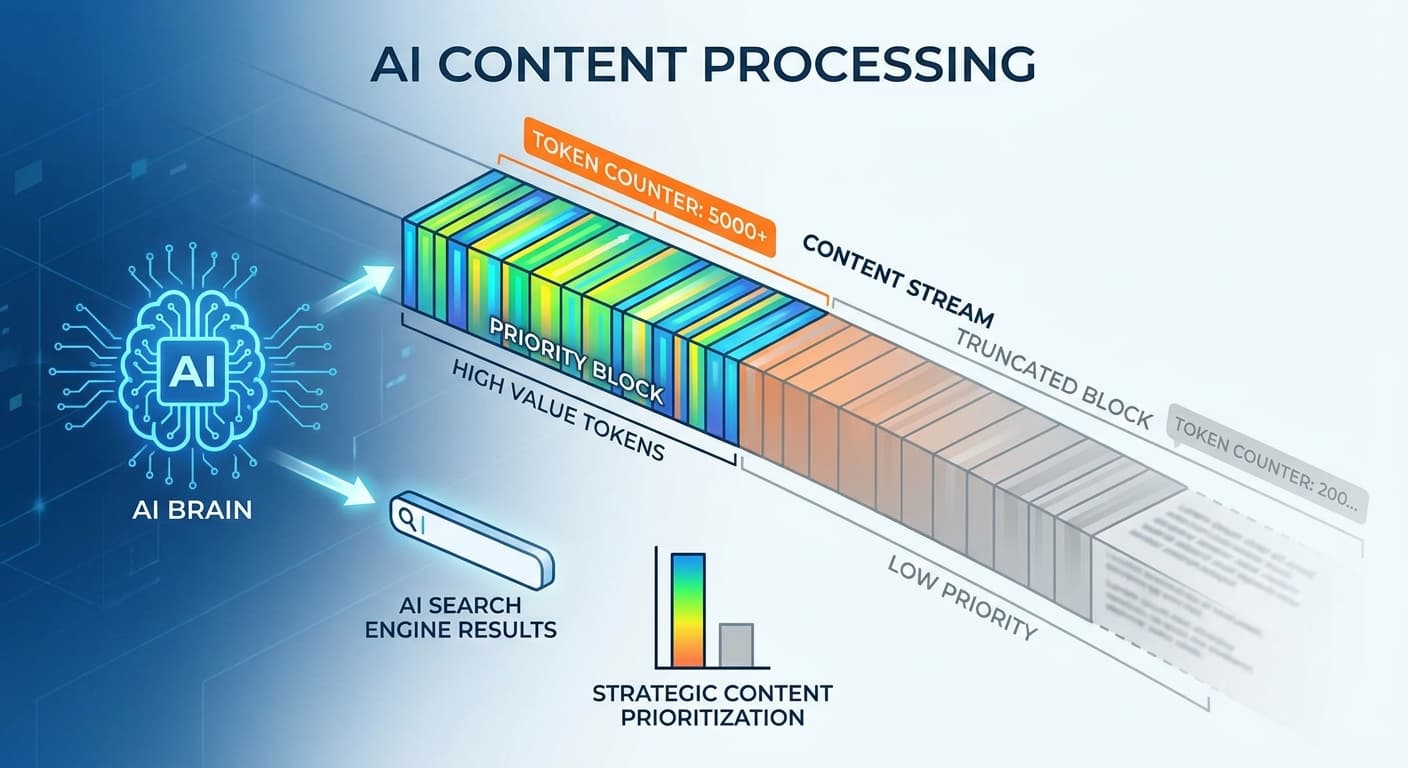
However, these limits include the entire conversation context, system prompts, and processing overhead. When users ask complex questions requiring the AI to analyze multiple sources simultaneously, your individual article may only receive 2,000-4,000 tokens of attention—roughly 1,500-3,000 words.
What This Means for Content Creators
If your 6,000-word comprehensive guide gets truncated to its first 2,500 words, the AI never sees:
This "citation blindness" explains why shorter, well-structured articles often outperform longer, more comprehensive content in AI search results.
Understanding Token Window Prioritization
How AI Models Decide What to Keep
When faced with content that exceeds available tokens, AI models use various truncation strategies:
The Citation Evaluation Process
AI models evaluate content for citation worthiness based on:
If your unique insights appear after the truncation point, they're invisible to this evaluation process.
Building Your Token Window Strategy
1. Front-Load Your Most Valuable Content
The Golden Rule: Place your most cite-worthy information in the first 2,000 words of any article.
Implementation tactics:
Example Structure:
Introduction (300 words) + Key Insight #1 (500 words)
↓
Main Arguments with Data (800 words)
↓
Supporting Evidence (400 words)
↓
[Everything else comes after the "safety zone"]
2. Create Strategic Content Layering
The Inverted Pyramid Approach:
This ensures that even with aggressive truncation, your most valuable content remains visible to AI evaluation systems.
3. Implement Token-Aware Structural Optimization
H2 and H3 Optimization:
Strategic Repetition:
4. Optimize for Multiple Truncation Scenarios
Create Multiple "Citation Points":
This approach ensures that regardless of where truncation occurs, you have citation-worthy content in the visible portion.
Advanced Token Window Strategies
Content Chunking for AI Consumption
The 2000-Word Module Method:
Break long-form content into 2000-word modules, each capable of standing alone:
Each module should be citation-worthy independently.
Query-Intent Mapping
Predict and Prioritize:
Platform-Specific Optimization
Different AI platforms have varying truncation behaviors:
ChatGPT: Favors structured, conversational content with clear headings
Perplexity: Prioritizes data-rich content with citations
Claude: Values nuanced analysis and context
Gemini: Responds well to multimedia-supported content
Tailor your front-loading strategy to your target platforms.
Measuring Token Window Performance
Key Metrics to Track
Testing and Optimization
A/B Testing Structure:
Content Analysis:
How Citescope Ai Helps Optimize for Token Windows
Citescope Ai's GEO Score specifically analyzes your content's AI Interpretability dimension, which includes token window optimization factors. The platform evaluates:
The AI Rewriter feature automatically restructures your content to prioritize the most valuable information within the critical first 2,000 words, ensuring your best insights reach AI evaluation systems. Plus, the Citation Tracker helps you identify which content positioning strategies generate the most AI citations across ChatGPT, Perplexity, Claude, and Gemini.
Implementation Checklist
Before Publishing Long-Form Content:
Monthly Review Process:
Ready to Optimize for AI Search?
Don't let token window limitations hide your best content from AI citation systems. Citescope Ai's GEO Score and AI Rewriter help you structure content for maximum AI visibility, ensuring your most valuable insights reach the evaluation process. Start with our free tier today and discover how token window optimization can increase your AI search citations by up to 40%.
Try Citescope Ai free and transform your long-form content into an AI citation magnet. Your comprehensive guides deserve to be discovered—let's make sure AI search engines can actually see them.