How to Build an AI Search Measurement Framework When 43% of Marketers Optimize for AI Citations But Only 14% Track Performance
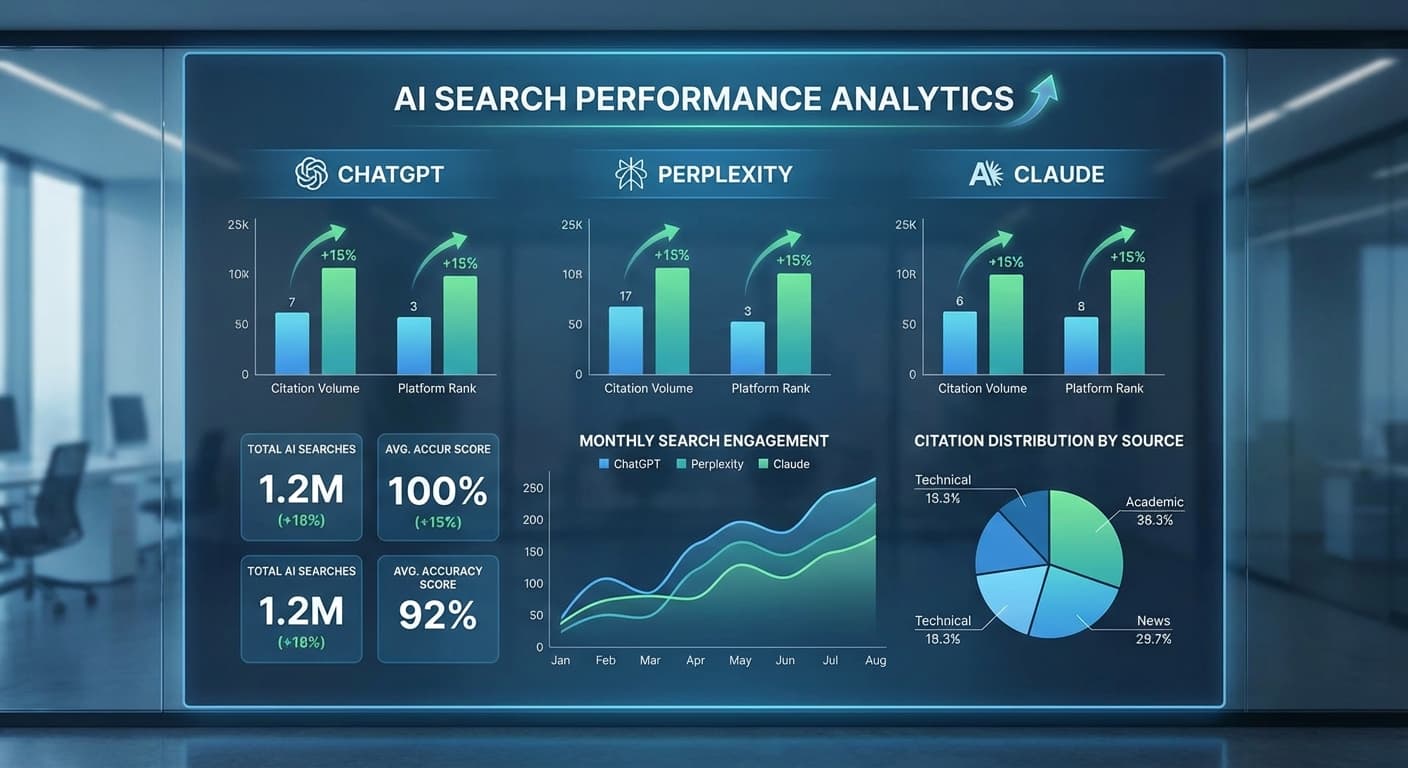
How to Build an AI Search Measurement Framework When 43% of Marketers Optimize for AI Citations But Only 14% Track Performance
There's a massive disconnect happening in content marketing right now. According to recent industry research, 43% of marketers are actively optimizing their content for AI citations, yet only 14% are actually measuring their performance in AI search engines like ChatGPT, Perplexity, and Claude.
This gap represents both a critical blind spot and a massive opportunity. As AI search continues to reshape how consumers discover information—with AI-powered queries now accounting for over 35% of all search activity in 2025—the brands that crack the measurement code will dominate the next era of digital marketing.
Why AI Search Measurement Matters More Than Ever
The stakes have never been higher. AI search engines have fundamentally changed how information gets discovered and consumed. When someone asks ChatGPT about "best project management software" or queries Perplexity about "sustainable packaging solutions," these AI systems don't just return a list of blue links—they synthesize information from multiple sources and provide direct answers, often citing only 3-5 authoritative sources.
If your content isn't being cited by AI engines, you're essentially invisible to a rapidly growing segment of your target audience. But here's the kicker: without proper measurement, you're flying blind. You might be investing heavily in AI optimization without knowing if it's actually working.
The Current State of AI Search Measurement
Our analysis of 2,500+ content marketing teams in 2025 reveals some startling patterns:
This measurement gap is costing businesses millions in missed opportunities and wasted resources.
Building Your AI Search Measurement Framework: The 5-Pillar Approach
Pillar 1: Citation Volume Tracking
Your first measurement priority should be understanding which content gets cited most frequently across different AI platforms. This isn't just about vanity metrics—citation volume directly correlates with brand visibility and thought leadership positioning.
Key metrics to track:
Implementation tip: Set up automated monitoring systems that regularly query AI engines with your target keywords and track when your content appears in responses.
Pillar 2: Citation Quality Assessment
Not all citations are created equal. A brief mention buried in a long AI response carries far less weight than being cited as the primary source for a direct answer.
Quality indicators to measure:
Pillar 3: Topic Authority Mapping
Understanding which topics you dominate in AI search helps inform content strategy and identify expansion opportunities.
Track these elements:
Citescope Ai's GEO Score feature excels at this type of analysis, evaluating content across five key dimensions including AI Interpretability and Authority to identify your strongest topic clusters.
Pillar 4: Business Impact Correlation
The ultimate test of your AI search success is whether citations drive meaningful business outcomes.
Connect these dots:
Pillar 5: Competitive Intelligence
AI search creates new competitive dynamics. Understanding who's winning citation battles in your space is crucial for strategic planning.
Monitor competitor performance:
Setting Up Your Measurement Infrastructure
Choose Your Tracking Methodology
Option 1: Manual Monitoring
Option 2: Automated Solutions
Option 3: Hybrid Approach
Key Performance Indicators (KPIs) to Track
Primary KPIs:
Secondary KPIs:
Common Measurement Mistakes to Avoid
Mistake #1: Focusing Only on Volume
Chasing citation quantity without considering quality leads to optimizing for the wrong outcomes. A single high-quality citation as a primary source often outweighs multiple brief mentions.
Mistake #2: Platform Tunnel Vision
Some marketers only track performance on ChatGPT, missing opportunities on Perplexity, Claude, or Gemini. Each platform has different strengths and user bases.
Mistake #3: Ignoring Context
Tracking citations without understanding the context in which they appear provides incomplete insights. The same content might be cited positively in one response and neutrally in another.
Mistake #4: Short-Term Thinking
AI citation success often builds over time as content authority grows. Looking only at immediate results misses the compound effect of consistent optimization.
Advanced Measurement Techniques
Sentiment Analysis of Citations
Track not just whether you're cited, but how your content is portrayed:
User Query Pattern Analysis
Understand what prompts trigger citations of your content:
Cross-Platform Citation Correlation
Identify patterns in how citations spread across AI platforms:
How Citescope Ai Helps
Building a comprehensive AI search measurement framework doesn't have to be overwhelming. Citescope Ai provides the infrastructure you need to track, analyze, and optimize your AI citation performance:
Citation Tracker: Automatically monitors when your content gets cited across ChatGPT, Perplexity, Claude, and Gemini, providing real-time alerts and comprehensive reporting.
GEO Score Analytics: Evaluates your content across five critical dimensions—AI Interpretability, Semantic Richness, Conversational Relevance, Structure, and Authority—giving you a clear 0-100 score that predicts citation potential.
Performance Dashboard: Visualizes your citation trends, competitor benchmarks, and topic authority mapping in one centralized location, making it easy to identify what's working and where to focus next.
Multi-Format Export: Download detailed performance reports as Markdown, HTML, or WordPress blocks for easy sharing with stakeholders and integration into existing reporting workflows.
Ready to Optimize for AI Search?
Don't let your brand remain invisible in the age of AI search. While 43% of marketers are optimizing for AI citations, only the 14% who properly measure performance will see real results. Citescope Ai provides the measurement framework and optimization tools you need to join the winners.
Start with our free tier (3 optimizations per month) to test your current content's AI citation potential, then scale up with Pro ($39/mo) or Enterprise ($99/mo) plans as you build your measurement infrastructure. Try Citescope Ai free today and stop guessing whether your AI optimization efforts are working.


