How to Build an AI Search Fragmentation Strategy When Enterprise Buyers Use 4+ Different AI Assistants Per Purchase Journey
How to Build an AI Search Fragmentation Strategy When Enterprise Buyers Use 4+ Different AI Assistants Per Purchase Journey
Did you know that 73% of enterprise buyers now use four or more different AI assistants during a single purchasing journey? Yet most B2B companies are still optimizing their content for just one platform—usually ChatGPT. This fragmentation is creating massive blind spots in B2B marketing strategies.
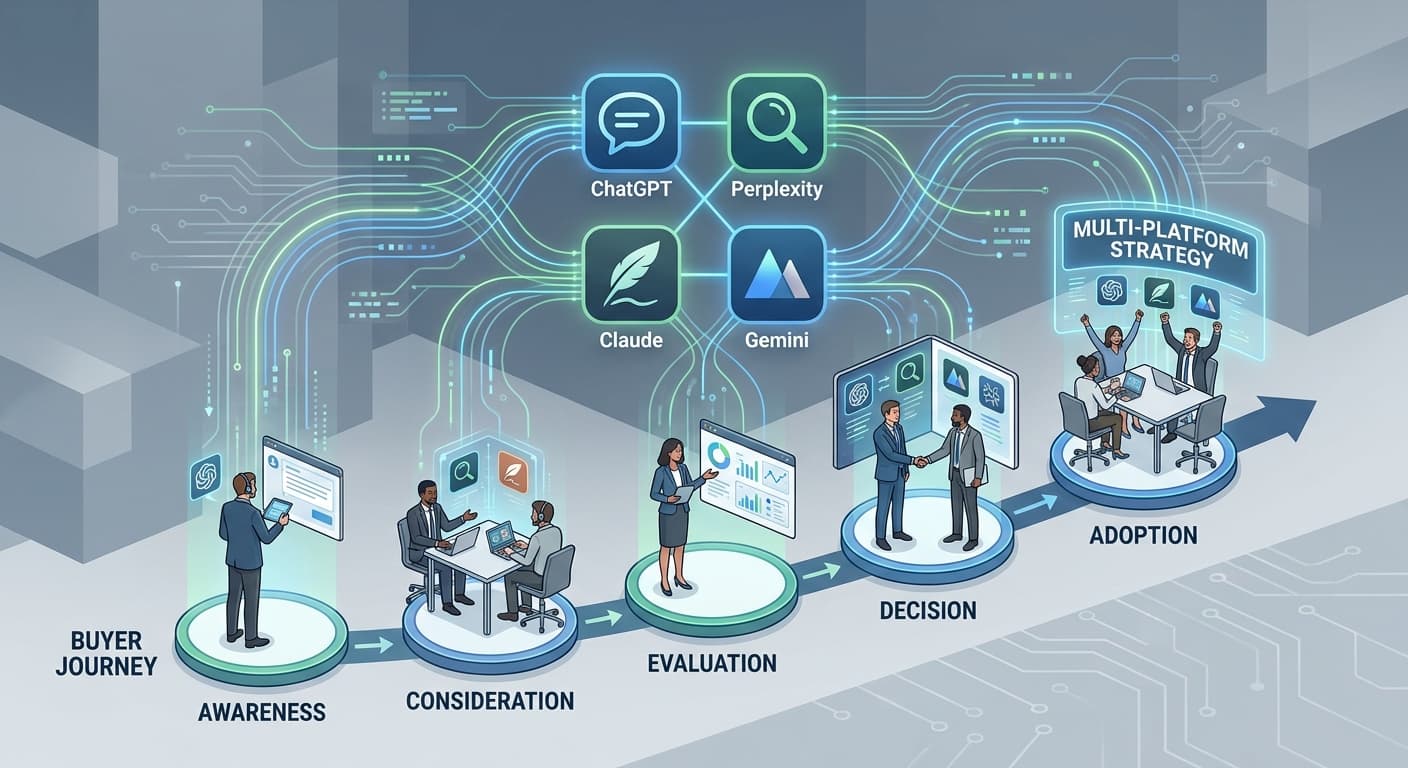
As we navigate through 2026, enterprise decision-makers are no longer loyal to a single AI assistant. They might start their research with Perplexity for market insights, move to Claude for technical analysis, use ChatGPT for vendor comparisons, and finish with Gemini for financial projections. If your content isn't visible across all these touchpoints, you're missing critical opportunities to influence the buyer journey.
The Reality of AI Search Fragmentation in Enterprise Buying
The enterprise buying landscape has fundamentally shifted. Recent data shows that:
This fragmentation isn't random—different AI assistants excel at different tasks, and sophisticated buyers leverage these strengths strategically.
Why Enterprise Buyers Use Multiple AI Assistants
Enterprise buyers aren't using multiple AI platforms by accident. Each serves specific purposes:
Research and Discovery Phase:
Evaluation and Comparison:
Decision and Procurement:
The Cost of Single-Platform Optimization
Relying solely on ChatGPT optimization is like advertising only on one TV channel when your audience watches four different networks. The consequences are measurable:
One enterprise software company discovered they were losing 60% of potential citations because their content was only optimized for ChatGPT's training patterns, missing opportunities on Perplexity and Claude where their target audience was equally active.
Building Your AI Search Fragmentation Strategy
1. Map Your Buyer's AI Journey
Start by understanding which AI assistants your buyers use at each stage:
Discovery Stage:
Evaluation Stage:
Decision Stage:
2. Develop Platform-Specific Content Optimization
Each AI assistant has unique strengths and content preferences:
For ChatGPT:
For Perplexity:
For Claude:
For Gemini:
3. Create Modular Content Architecture
Develop content that can be optimized for multiple platforms simultaneously:
Core Content Modules:
Platform-Specific Enhancements:
4. Implement Cross-Platform Citation Tracking
Monitor your visibility across all major AI platforms:
Citescope Ai's Citation Tracker makes this process seamless by monitoring mentions across ChatGPT, Perplexity, Claude, and Gemini simultaneously, giving you a complete picture of your AI search performance.
5. Optimize for AI-Specific Query Patterns
Different AI assistants surface different types of queries:
ChatGPT Patterns:
Perplexity Patterns:
Claude Patterns:
Gemini Patterns:
Advanced Fragmentation Tactics
Content Syndication Strategy
Create a hub-and-spoke model where:
Multi-Platform Keyword Research
Expand beyond traditional SEO keywords to include:
Attribution and Measurement
Track the complete customer journey across platforms:
How Citescope Ai Helps
Building an effective AI search fragmentation strategy requires sophisticated monitoring and optimization across multiple platforms. Citescope Ai simplifies this complex challenge:
GEO Score Analysis: Evaluate how well your content performs across different AI platforms with our comprehensive scoring system that analyzes AI Interpretability, Semantic Richness, Conversational Relevance, Structure, and Authority.
Multi-Platform Optimization: Our AI Rewriter optimizes your content for multiple AI assistants simultaneously, ensuring maximum visibility across ChatGPT, Perplexity, Claude, and Gemini.
Comprehensive Citation Tracking: Monitor mentions and citations across all major AI platforms in one dashboard, identifying gaps and opportunities in your fragmentation strategy.
Export Flexibility: Download optimized content in multiple formats (Markdown, HTML, WordPress blocks) for easy distribution across your content ecosystem.
Implementation Timeline
Week 1-2: Buyer journey mapping and platform audit
Week 3-4: Content architecture development
Week 5-8: Platform-specific optimization implementation
Week 9-12: Monitoring setup and performance baseline
Week 13+: Continuous optimization and refinement
Measuring Success
Key metrics for your fragmentation strategy:
Common Pitfalls to Avoid
Ready to Optimize for AI Search?
The enterprise buying journey is now fundamentally multi-platform, and your content strategy must evolve accordingly. Citescope Ai provides the tools and insights you need to build an effective AI search fragmentation strategy that captures buyers at every touchpoint.
Start with our free tier to analyze your current AI search performance across platforms, then upgrade to Pro for comprehensive optimization and tracking capabilities. Don't let fragmentation fragment your revenue—start building your multi-platform AI search strategy today.