GEO Strategy

How to Build a Product Feed Hygiene Strategy When AI Search Engines Surface Stale Pricing and Availability Data in 58% of Ecommerce Recommendations
May 18, 20267 min read
How to Build a Product Feed Hygiene Strategy When AI Search Engines Surface Stale Pricing and Availability Data in 58% of Ecommerce Recommendations

How to Build a Product Feed Hygiene Strategy When AI Search Engines Surface Stale Pricing and Availability Data in 58% of Ecommerce Recommendations

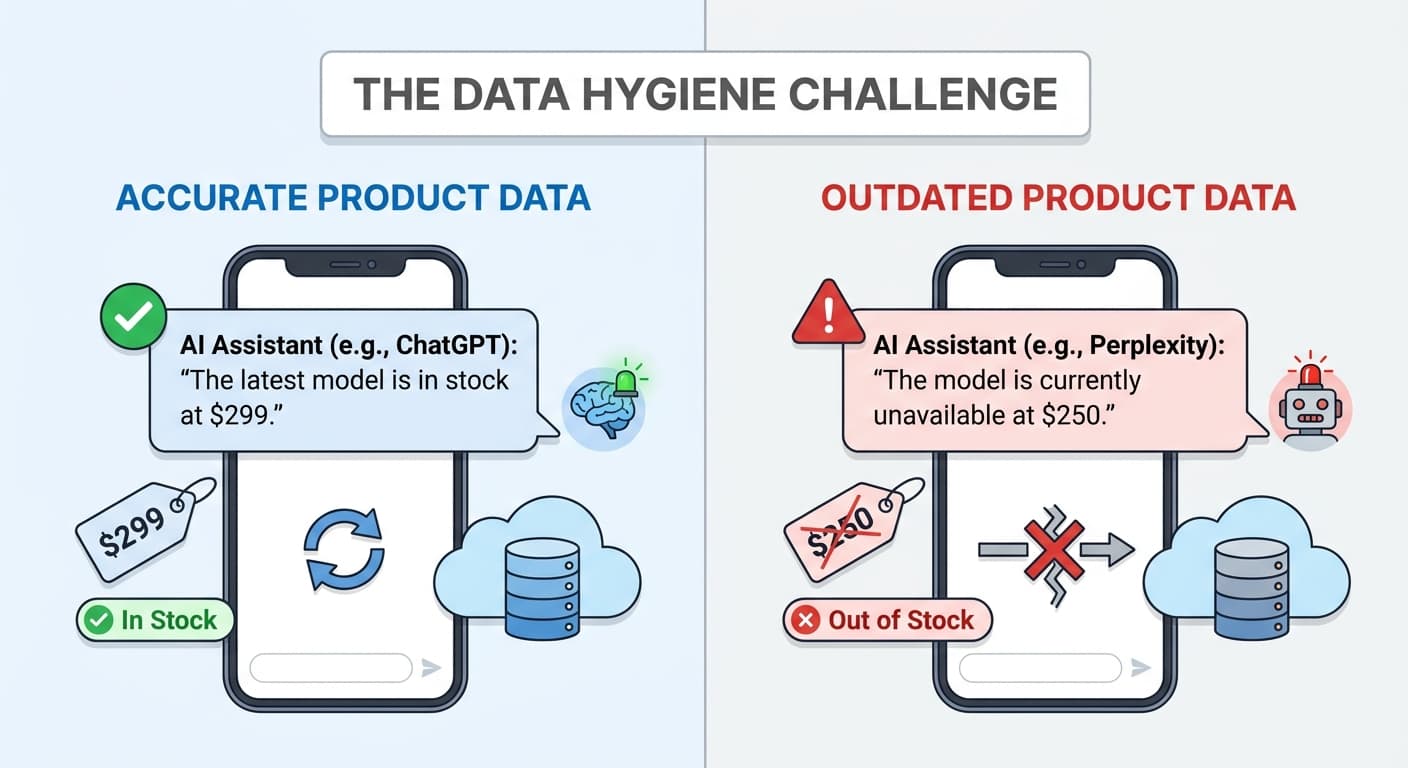
Imagine this: A potential customer asks ChatGPT for the "best budget wireless earbuds under $50" and your product appears in the recommendation with yesterday's sale price—except your sale ended this morning, and the AI is now promoting outdated information to millions of users. This scenario is playing out thousands of times daily as AI search engines increasingly rely on product data that's hours, days, or even weeks out of date.

According to recent analysis from 2025, AI search platforms surface stale pricing and availability data in 58% of ecommerce product recommendations. With AI search now accounting for over 35% of all product discovery queries and ChatGPT alone processing 600+ million weekly searches, this data hygiene crisis is costing retailers billions in lost revenue and customer trust.

The Growing Impact of AI Search on Ecommerce Discovery

The landscape of product discovery has fundamentally shifted. While traditional search engines update their product indexes every few hours to days, AI engines like Perplexity, Claude, and Gemini often work with cached data that can be significantly older. Here's what's happening:

  • Real-time expectations meet delayed data: 73% of Gen Z shoppers expect AI recommendations to reflect current pricing and availability

  • Cross-platform inconsistency: The same product query can yield different prices across different AI engines

  • Compound errors: Stale data gets amplified when AI engines reference each other's outdated information
  • Understanding the Data Decay Problem

    Product feed hygiene isn't just about having accurate data—it's about maintaining data freshness across multiple touchpoints where AI engines might encounter your products.

    Common Data Decay Patterns

    Price Volatility Issues

  • Flash sales that end but continue appearing in AI recommendations

  • Dynamic pricing changes not reflected in cached product schemas

  • Currency fluctuations affecting international product feeds
  • Inventory Synchronization Gaps

  • Out-of-stock products still showing as available

  • Limited-time offers that expired days ago

  • Seasonal availability changes not updated across platforms
  • Product Information Drift

  • Updated product specifications not reflected in AI training data

  • Discontinued products still appearing in recommendations

  • New product launches not appearing in AI search results for weeks
  • Building Your Product Feed Hygiene Strategy

    1. Establish Real-Time Data Validation Protocols

    Create automated systems that verify data accuracy across all customer touchpoints:

    Critical Validation Points:

  • Price accuracy within 15-minute windows

  • Inventory levels updated every 30 minutes

  • Promotional status verified hourly

  • Product availability confirmed across channels
  • Implementation Steps:

  • Set up automated price monitoring across your product catalog

  • Create inventory threshold alerts for popular items

  • Implement real-time feed validation before syndication

  • Establish backup data sources for critical product information
  • 2. Optimize for AI Engine Data Refresh Cycles

    Different AI platforms have varying data refresh patterns. Understanding these cycles helps you time your updates strategically:

    Platform-Specific Strategies:

  • ChatGPT: Updates product knowledge approximately every 2-4 weeks; prioritize structured data markup

  • Perplexity: Crawls more frequently but may cache pricing data; focus on real-time API feeds

  • Claude: Relies heavily on training data; ensure consistent product information across web presence

  • Gemini: Integrates with Google's product knowledge graph; maintain Google Merchant Center accuracy
  • 3. Implement Multi-Layer Data Syndication

    Create redundant pathways for AI engines to access your current product information:

    Primary Data Layers:

  • Structured data markup on product pages

  • XML/JSON feeds for aggregators and comparison sites

  • API endpoints for real-time data access

  • Social commerce integrations with current pricing
  • Secondary Reinforcement:

  • Press releases for major price changes or promotions

  • Social media posts with current offers

  • Blog content featuring updated product information

  • Email campaigns that AI might reference for context
  • 4. Create Proactive Correction Mechanisms

    When stale data does appear in AI recommendations, have systems in place to address it quickly:

    Monitoring Setup:

  • Daily searches across major AI platforms for your key products

  • Automated alerts when pricing discrepancies are detected

  • Customer feedback channels to report outdated AI recommendations

  • Competitor monitoring to identify industry-wide data issues
  • Correction Protocols:

  • Direct outreach to AI platform support when critical errors are found

  • Rapid content publication with corrected information

  • Social media corrections with proper hashtags and mentions

  • Updated structured data deployment within hours of detection
  • Advanced Feed Hygiene Techniques

    Dynamic Content Optimization

    Beyond basic data accuracy, optimize how your product information appears in AI contexts:

    Content Structure for AI Consumption:

  • Use clear, descriptive product titles that include key attributes

  • Write product descriptions that answer common AI search queries

  • Include context about pricing ("Starting at $X" vs. fixed pricing)

  • Specify availability windows ("Available until [date]" for limited offers)
  • Seasonal and Event-Based Hygiene

    Plan for predictable data challenges:

    Pre-Event Preparation:

  • Update feeds 48 hours before major sales events

  • Create special landing pages for AI-driven traffic

  • Prepare alternative product recommendations for sold-out items

  • Set up enhanced monitoring during high-traffic periods
  • Post-Event Cleanup:

  • Immediate removal of expired promotional content

  • Inventory level corrections after flash sales

  • Updated product recommendations based on new stock levels

  • Performance analysis to improve future event hygiene
  • Measuring Feed Hygiene Success

    Track these key metrics to evaluate your strategy:

    Data Accuracy Metrics:

  • Percentage of AI recommendations with current pricing (target: >95%)

  • Average time between price changes and AI reflection (target: <24 hours)

  • Customer complaints about outdated AI recommendations (target: <2% of AI-driven traffic)
  • Business Impact Metrics:

  • Conversion rate from AI-referred traffic

  • Revenue attribution from AI search channels

  • Customer satisfaction scores for AI-discovered products

  • Return/refund rates from AI-driven purchases
  • How Citescope Ai Helps

    Maintaining product feed hygiene across multiple AI platforms requires constant monitoring and optimization. Citescope Ai's Citation Tracker helps ecommerce brands monitor how their products appear across ChatGPT, Perplexity, Claude, and Gemini recommendations. The platform's GEO Score analyzes your product content across AI Interpretability, Semantic Richness, and Authority dimensions, helping you identify when product information might be at risk of appearing with stale data. The AI Rewriter can help restructure product descriptions to include temporal context and pricing transparency that reduces the impact of data lag.

    Implementation Timeline and Best Practices

    Week 1-2: Foundation Setup


  • Audit current product feed accuracy across all channels

  • Implement basic monitoring for price and inventory changes

  • Set up structured data markup on key product pages
  • Week 3-4: Advanced Monitoring


  • Deploy AI platform monitoring across ChatGPT, Perplexity, Claude, and Gemini

  • Create automated alert systems for data discrepancies

  • Establish correction protocols and response teams
  • Month 2+: Optimization and Scale


  • Analyze performance data to identify improvement opportunities

  • Scale successful hygiene practices across full product catalog

  • Develop predictive models for data decay patterns
  • Best Practices for Long-Term Success

  • Consistency is key: Regular, small updates perform better than infrequent major overhauls

  • Cross-team collaboration: Align marketing, inventory, and technical teams on data standards

  • Customer-first approach: Prioritize accuracy for products that drive the most AI referral traffic

  • Continuous learning: Stay updated on AI platform changes and adapt strategies accordingly
  • Ready to Optimize for AI Search?

    As AI search continues to reshape product discovery, maintaining accurate, fresh product data across all platforms becomes critical for ecommerce success. Citescope Ai helps brands monitor their citations across major AI search engines and optimize content for better visibility and accuracy. Start with our free tier to analyze your top products' AI performance—sign up today and ensure your products appear with current, compelling information when customers search.

    product feed optimizationAI search ecommercedata hygieneChatGPT commercepricing accuracy

    Track your AI visibility

    See how your content appears across ChatGPT, Perplexity, Claude, and more.

    Start for Free