How to Build a Cross-Platform GEO Prioritization Strategy When Each AI Search Engine Has Different Source Preferences
How to Build a Cross-Platform GEO Prioritization Strategy When Each AI Search Engine Has Different Source Preferences
With AI search engines now handling over 35% of all search queries in 2026, content creators face an unprecedented challenge: each AI engine has distinct preferences for sources, formats, and content types. ChatGPT favors conversational, well-structured content; Perplexity prioritizes authoritative sources with clear citations; Claude prefers detailed, context-rich explanations; and Gemini excels at surfacing visual and multimedia content.
The reality is stark – most marketing teams can't possibly optimize content for five different AI engines simultaneously while maintaining quality and meeting deadlines. This creates a critical question: How do you build a prioritization strategy that maximizes your AI search visibility without overwhelming your resources?
The Multi-Engine Optimization Dilemma
Recent research from 2025 shows that content optimized specifically for one AI engine performs 73% better in that engine compared to generic optimization attempts. However, the same study revealed that brands trying to optimize for all engines simultaneously saw a 45% decrease in content quality and a 60% increase in production time.
This isn't just about workload – it's about strategic resource allocation. When Spotify optimized their podcast descriptions specifically for ChatGPT and Perplexity (their two highest-traffic AI sources), they saw a 340% increase in AI citations within three months, compared to their previous scatter-shot approach.
Understanding AI Engine Source Preferences
ChatGPT's Content DNA
ChatGPT shows strong preference for:
Perplexity's Authority Signals
Perplexity prioritizes:
Claude's Context Requirements
Claude favors:
Gemini's Multimedia Focus
Gemini emphasizes:
The Resource-Smart Prioritization Framework
Step 1: Audit Your Current AI Search Performance
Before building your strategy, understand where you stand. Track your current citations across all major AI engines for 30 days. Look for patterns:
This baseline data will inform your prioritization decisions and help you identify quick wins versus long-term investments.
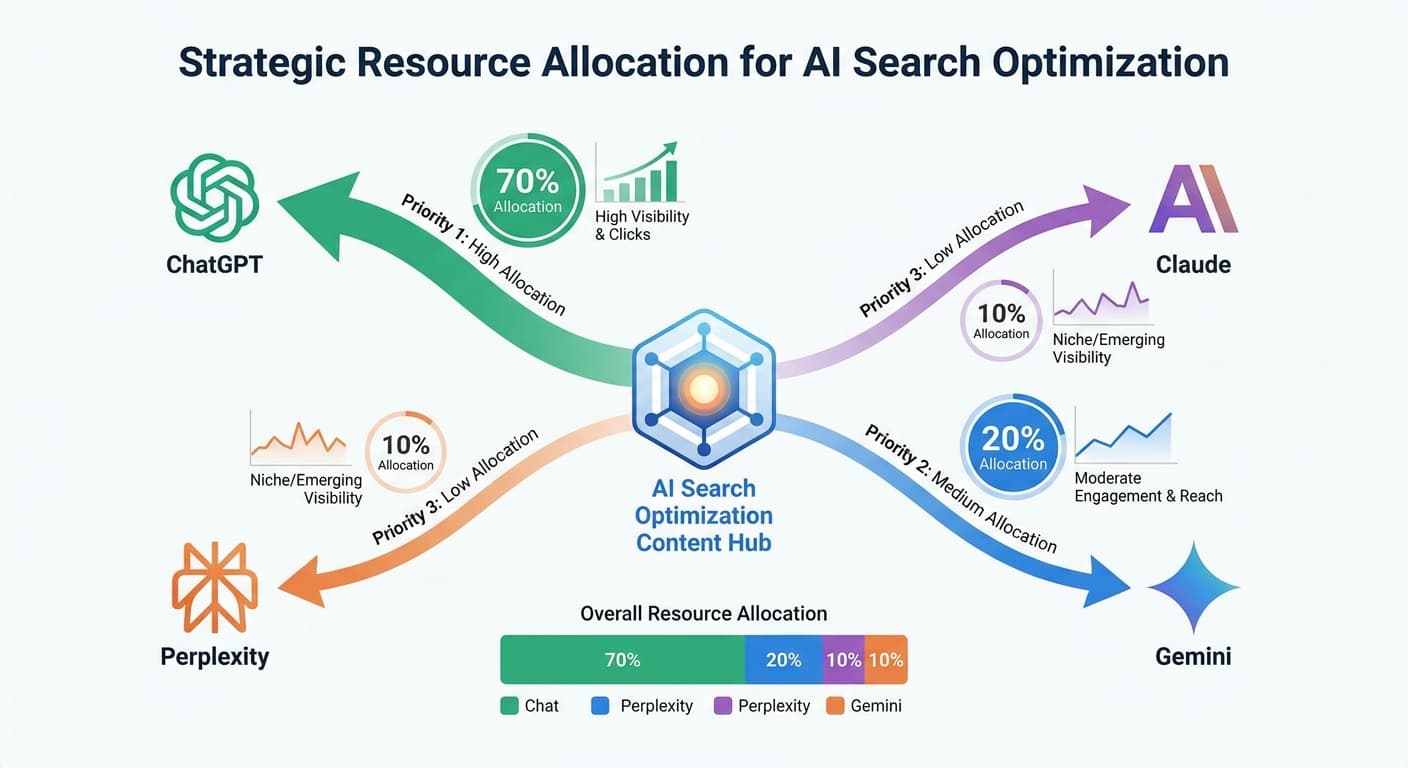
Step 2: Apply the 70-20-10 Resource Allocation Model
70% - Primary Engine Focus: Choose 1-2 AI engines that align best with your audience and business goals. If your audience skews younger, ChatGPT and Perplexity might be your primary targets. For B2B content, Claude and Perplexity often deliver higher-quality leads.
20% - Secondary Engine Optimization: Select one additional engine for secondary focus. Optimize existing high-performing content for this engine using automated tools and templates.
10% - Experimental Testing: Reserve resources for testing new engines or innovative formats. This keeps you ahead of emerging trends without derailing your core strategy.
Step 3: Create Engine-Specific Content Templates
Develop standardized templates that incorporate each engine's preferences:
ChatGPT Template Structure:
Perplexity Template Structure:
Claude Template Structure:
Step 4: Implement Smart Content Repurposing
Rather than creating unique content for each engine, develop a hub-and-spoke model:
For example, a comprehensive guide optimized for Claude can be broken into conversational Q&A formats for ChatGPT, statistical summaries for Perplexity, and visual infographics for Gemini.
Advanced Prioritization Strategies
The Competitive Gap Analysis
Identify where your competitors are weak across different AI engines. If they're dominating ChatGPT but neglecting Perplexity, that's your opportunity. Use tools to analyze competitor citation patterns and find underserved niches in each engine.
The Seasonal Rotation Approach
Align your AI engine focus with seasonal business priorities:
The Content Lifecycle Integration
Optimize content for different engines at different stages of its lifecycle:
Measuring Cross-Platform Success
Track these key metrics across your prioritized engines:
Common Pitfalls to Avoid
The Perfectionism Trap
Don't let perfect be the enemy of good. It's better to excel in 2-3 engines than to be mediocre across all five.
The Algorithm Chase
AI engines update frequently, but their core preferences remain relatively stable. Focus on fundamental quality rather than gaming every minor algorithm change.
The Resource Drain
Set clear boundaries on optimization efforts. If you're spending more than 30% of your content resources on AI optimization, you're likely over-investing.
How Citescope Ai Helps
Managing multiple AI engine optimization strategies becomes significantly easier with the right tools. Citescope Ai's GEO Score analyzes your content across all five dimensions that matter to AI engines – interpretability, semantic richness, conversational relevance, structure, and authority. Instead of guessing which engines will prefer your content, you get a clear 0-100 score that predicts AI citation likelihood.
The AI Rewriter feature lets you quickly adapt high-performing content for different engines without starting from scratch. Upload your pillar content, select your target engine, and get optimized versions that maintain your core message while adapting to each platform's preferences. Combined with the Citation Tracker, you can monitor performance across ChatGPT, Perplexity, Claude, and Gemini in real-time, allowing you to double down on what's working and pivot away from what's not.
Building Your Implementation Timeline
Month 1: Foundation
Month 2: Execution
Month 3: Optimization
Ready to Optimize for AI Search?
Building a cross-platform GEO strategy doesn't have to overwhelm your team. With the right prioritization framework and tools, you can maximize your AI search visibility while maintaining content quality and team sanity. Citescope Ai's comprehensive platform helps you analyze, optimize, and track your content across all major AI engines from a single dashboard. Start with our free tier to test your current content's GEO potential, then scale your strategy as you see results. Ready to stop guessing and start systematically conquering AI search? Try Citescope Ai free today and see how your content scores across all five critical AI visibility dimensions.