AI & SEO

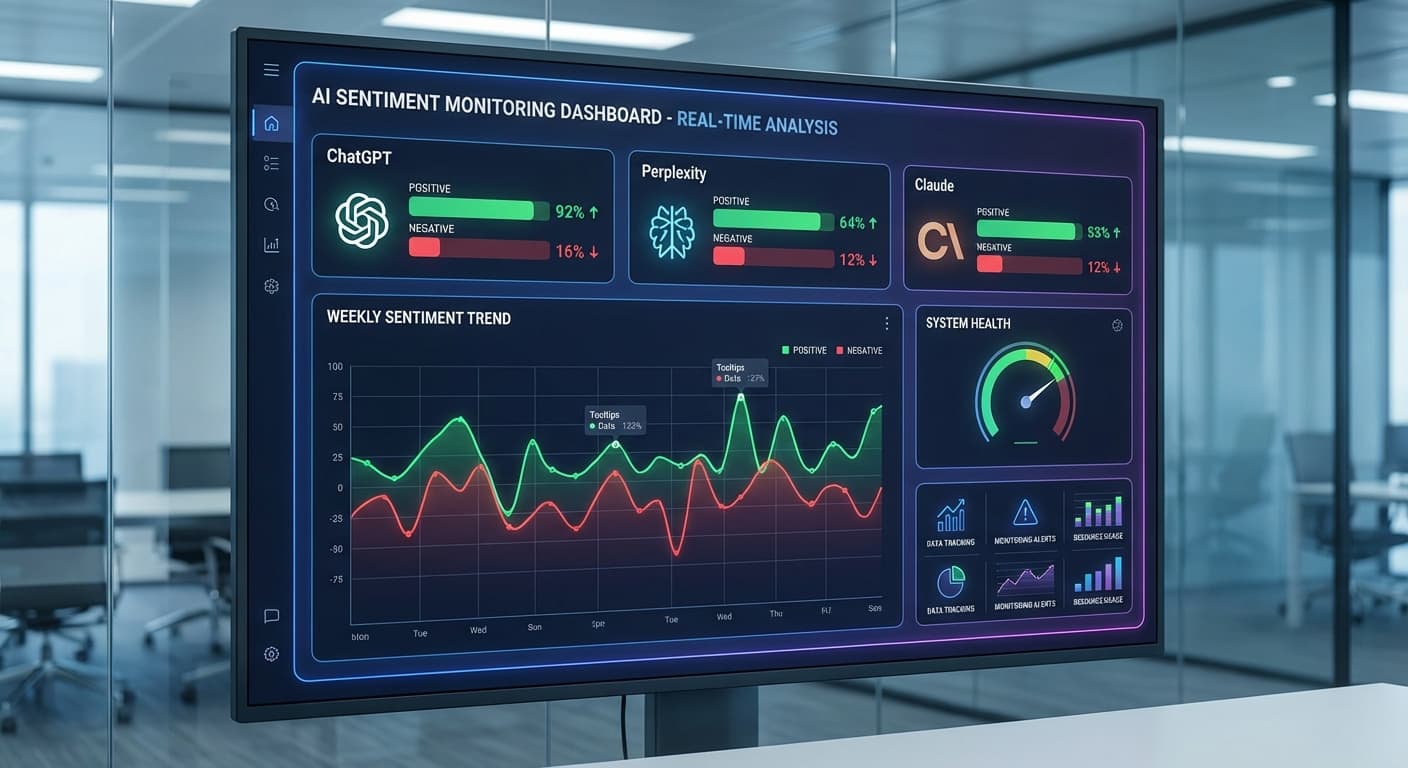
How to Build a Contextual Sentiment Tracking System for AI-Generated Brand Citations
April 12, 20267 min read
How to Build a Contextual Sentiment Tracking System for AI-Generated Brand Citations

How to Build a Contextual Sentiment Tracking System for AI-Generated Brand Citations

A Fortune 500 marketing director recently discovered something shocking: while her brand was getting cited in 73% of relevant AI search results, 42% of those citations were framing her company negatively—and her traditional analytics tools showed zero visibility into this trend. She only found out when a customer mentioned seeing a "concerning AI response" about her product.

This scenario is playing out across thousands of businesses in 2025. With AI search now powering over 35% of all queries and ChatGPT alone serving 650+ million weekly users, the way AI engines frame your brand in their responses has become more crucial than traditional search rankings. Yet most companies are flying blind when it comes to understanding the sentiment and context of their AI citations.

The Hidden Crisis in AI Citation Sentiment

Traditional sentiment analysis tools were built for a different era—one where you could track mentions across social media platforms and review sites. But AI engines don't just mention your brand; they synthesize information about you into coherent, authoritative-sounding responses that users trust implicitly.

Here's what makes AI citation sentiment uniquely challenging:

  • Contextual Complexity: AI engines might cite your brand positively for one aspect while negatively for another, all within the same response

  • Implied Sentiment: The tone isn't always explicit—subtle word choices and positioning can convey bias

  • Comparative Framing: Your brand might be cited neutrally but positioned unfavorably against competitors

  • Source Contamination: Negative sentiment from outdated or biased sources gets amplified through AI responses
  • Building Your Contextual Sentiment Tracking Framework

    Step 1: Map Your AI Citation Landscape

    Before you can track sentiment, you need to understand where and how your brand appears in AI responses. Start by creating a comprehensive citation audit:

    Query Categories to Monitor:

  • Direct brand searches ("[Your Company] reviews")

  • Problem-solution queries ("best [product category] for [specific need]")

  • Comparison queries ("[Your Brand] vs [Competitor]")

  • Industry trend questions ("top [industry] companies 2025")
  • AI Platforms to Track:

  • ChatGPT (largest user base at 650M+ weekly users)

  • Perplexity (fastest-growing AI search engine)

  • Claude (popular among professionals)

  • Google Bard/Gemini (integrated with search)

  • Microsoft Copilot (enterprise focus)
  • Step 2: Develop Contextual Sentiment Indicators

    Traditional sentiment analysis relies on obvious positive/negative language. AI citation sentiment requires more nuanced indicators:

    Positive Sentiment Signals:

  • Leading position in lists or comparisons

  • Descriptive language: "innovative," "reliable," "industry-leading"

  • Recommended context: "best choice for," "top option"

  • Comprehensive feature coverage
  • Negative Sentiment Signals:

  • Qualifying language: "however," "but," "despite"

  • Comparison disadvantages: "while not as [positive trait] as"

  • Limited use cases: "only suitable for"

  • Outdated information positioning your brand behind current trends
  • Neutral-Negative Indicators:

  • Generic descriptions without differentiators

  • Buried positioning (mentioned last in lists)

  • Feature focus on basic capabilities only

  • Lack of current information or achievements
  • Step 3: Create Your Monitoring Infrastructure

    Manual Monitoring (Start Here):

  • Weekly query testing across key AI platforms

  • Screenshot and document response variations

  • Track sentiment shifts over time

  • Note source citations when available
  • Automated Approaches:

  • API access where available (Perplexity offers limited API access)

  • Browser automation tools for systematic query testing

  • Natural language processing for sentiment classification

  • Alert systems for significant sentiment changes
  • Tools like Citescope Ai can significantly streamline this process by automatically tracking when and how your content gets cited across major AI engines, giving you real-time visibility into citation patterns and sentiment context.

    Step 4: Implement Response Classification

    Develop a systematic approach to categorizing AI responses:

    Sentiment Scale:

  • Highly Positive (+2): Recommended as top choice

  • Positive (+1): Generally favorable mention

  • Neutral (0): Factual mention without bias

  • Negative (-1): Qualified or limited recommendation

  • Highly Negative (-2): Cautioned against or criticized
  • Context Categories:

  • Product/Service Quality

  • Pricing and Value

  • Customer Service

  • Innovation and Features

  • Market Position

  • Reliability and Trust
  • Step 5: Build Actionable Response Protocols

    For Negative Sentiment Detection:

  • Identify source content driving negative framing

  • Create authoritative content addressing concerns

  • Update factual information across owned channels

  • Engage with review platforms if sentiment stems from outdated reviews
  • For Neutral/Missing Citations:

  • Optimize content for better AI discoverability

  • Enhance topical authority through comprehensive content

  • Improve content structure and semantic clarity

  • Build authoritative backlinks to key content
  • Advanced Sentiment Analysis Techniques

    Competitive Context Mapping

    Monitor not just your brand sentiment, but how it's positioned relative to competitors:

  • Track market share of voice in AI responses

  • Analyze sentiment gaps between you and competitors

  • Identify opportunities where competitors are framed negatively

  • Map sentiment trends to business metrics
  • Temporal Sentiment Tracking

    AI engines update their knowledge bases regularly. Track sentiment changes over time:

  • Monthly sentiment trend analysis

  • Correlation with content publishing or PR campaigns

  • Seasonal sentiment variations

  • Impact measurement of optimization efforts
  • Source Attribution Analysis

    When AI engines provide source citations, analyze:

  • Which sources drive positive vs. negative sentiment

  • Recency bias in source selection

  • Authority weight given to different source types

  • Geographic bias in source selection
  • Measuring ROI and Business Impact

    Connect your sentiment tracking to business outcomes:

    Leading Indicators:

  • Sentiment score improvements

  • Increased citation frequency

  • Better competitive positioning in AI responses
  • Lagging Indicators:

  • Brand awareness survey results

  • Organic traffic from AI-referred users

  • Customer acquisition cost changes

  • Brand equity measurements
  • How Citescope Ai Helps

    Building a comprehensive contextual sentiment tracking system manually is time-intensive and prone to gaps. Citescope Ai addresses this challenge through:

  • Automated Citation Monitoring: Track when your content gets cited across ChatGPT, Perplexity, Claude, and Gemini automatically

  • Context Analysis: Understand not just whether you're cited, but how your brand is positioned and framed

  • GEO Score Insights: Get actionable feedback on how to optimize your content for better AI visibility and more favorable citations

  • Competitive Intelligence: See how your citation performance compares to competitors in the AI search landscape
  • The platform's Citation Tracker specifically addresses the blind spots in traditional analytics by providing real-time visibility into your AI search presence, including the context and sentiment of your citations.

    Common Implementation Pitfalls to Avoid

    Over-Reliance on Keyword Matching: AI sentiment often exists in subtle context, not obvious positive/negative words.

    Ignoring Comparative Context: Your brand might be described positively but positioned unfavorably against competitors.

    Manual-Only Approaches: The scale of AI search requires some automation for comprehensive coverage.

    Reactive-Only Strategy: Focus on proactive content optimization, not just responding to negative citations.

    The Future of AI Citation Sentiment

    As AI search continues to grow—with projections showing 50%+ of all searches being AI-mediated by 2027—contextual sentiment tracking will become as crucial as traditional SEO. Early adopters who build robust tracking systems now will have significant advantages in:

  • Brand perception management

  • Competitive positioning

  • Content strategy optimization

  • Customer trust building
  • Ready to Optimize for AI Search?

    Building a contextual sentiment tracking system doesn't have to be overwhelming. Start with the framework above, focus on your most important queries, and gradually expand your monitoring scope.

    Citescope Ai can accelerate this process significantly by providing automated citation tracking and context analysis across all major AI engines. Our free tier includes 3 content optimizations per month—perfect for testing how improved content performs in AI search results.

    Start your free trial today and gain visibility into how AI engines are framing your brand. With real-time citation tracking and actionable optimization insights, you'll never be caught off guard by negative AI citations again.


    AI CitationsSentiment AnalysisBrand MonitoringAI Search OptimizationGEO Strategy

    Track your AI visibility

    See how your content appears across ChatGPT, Perplexity, Claude, and more.

    Start for Free