How to Build a Content Architecture for Hyper-Personalized AI Search When Two Users Asking Identical Questions Get Completely Different Answers
How to Build a Content Architecture for Hyper-Personalized AI Search When Two Users Asking Identical Questions Get Completely Different Answers
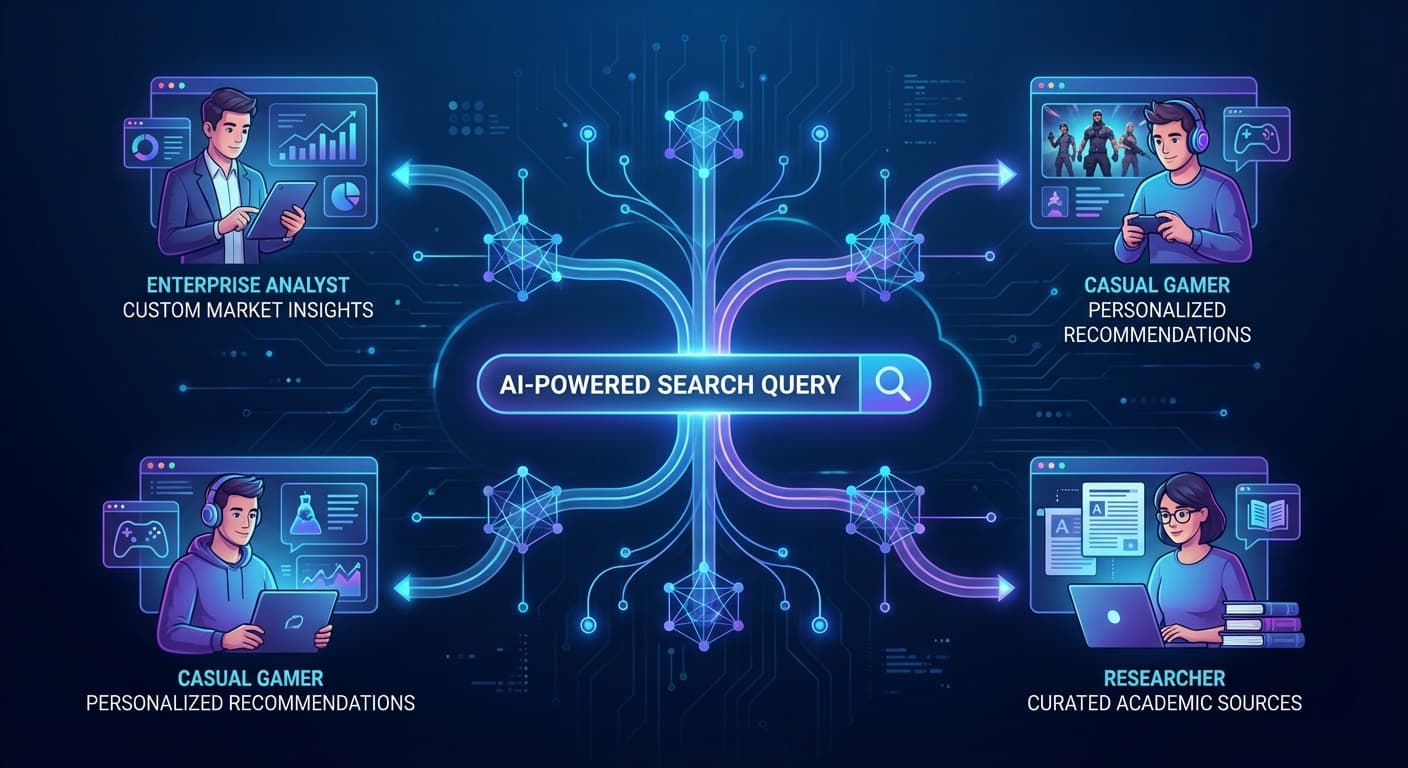
Imagine this: Two users ask ChatGPT the exact same question about "best project management tools for small businesses," but one gets a response focused on budget-friendly solutions while the other receives recommendations for enterprise-grade platforms. This isn't a bug—it's the new reality of hyper-personalized AI search in 2026.
With over 600 million weekly ChatGPT users and AI search now accounting for 35% of all online queries, the era of one-size-fits-all content is officially over. Today's AI engines don't just understand what users ask—they understand who's asking, when they're asking, and why they might be asking it.
The New Reality of AI Personalization in 2026
AI search engines have evolved far beyond simple keyword matching. They now consider:
This means the same question can trigger completely different response pathways depending on who's asking. A small business owner and an enterprise executive asking about "team collaboration tools" will receive vastly different recommendations, even with identical phrasing.
Understanding the Personalization Layers
Layer 1: Contextual User Profiling
AI engines build dynamic user profiles based on:
Layer 2: Situational Adaptation
Beyond user profiles, AI considers situational factors:
Layer 3: Conversational Memory
Modern AI engines maintain conversation continuity across sessions, remembering:
Building Your Multi-Dimensional Content Architecture
Strategy 1: Create Content Variants for Different User Archetypes
Instead of writing one piece about "email marketing best practices," develop multiple versions:
For Beginners:
For Advanced Users:
For Different Industries:
Strategy 2: Implement Contextual Content Layers
Structure your content with multiple entry points and depth levels:
#### The Pyramid Approach:
This allows AI engines to pull the most relevant information based on user sophistication and intent depth.
Strategy 3: Design for Intent Diversity
The same topic can serve different intents:
Create content that addresses all intent types within your topic clusters.
Advanced Personalization Techniques
Technique 1: Semantic Richness Optimization
Develop content with multiple semantic pathways:
This gives AI engines flexibility in matching content to user communication styles and comprehension preferences.
Technique 2: Conditional Content Structures
Organize information to support different retrieval patterns:
markdown
Topic Overview
[Universal introduction]
For Small Businesses
[Specific considerations]
For Enterprises
[Different focus areas]
Implementation Steps
Basic Approach
[Simplified process]
Advanced Implementation
[Complex strategies]
This structure allows AI to extract relevant sections based on user context while maintaining content cohesion.
Technique 3: Dynamic Resource Linking
Create content webs that support different user journeys:
Measuring Success in Personalized AI Search
Key Metrics to Track:
Advanced Analytics Considerations:
Platform-Specific Personalization Strategies
ChatGPT Optimization:
Perplexity Optimization:
Claude Optimization:
How Citescope Ai Helps Navigate Personalized AI Search
With personalization complexity increasing exponentially, manual optimization becomes nearly impossible. Citescope Ai's advanced analytics help you understand exactly how your content performs across different personalization scenarios.
Our Citation Tracker reveals not just when you're cited, but the context of those citations—showing you which user types, query variations, and conversation threads are driving traffic. The GEO Score analyzes your content's adaptability across multiple personalization dimensions, while the AI Rewriter optimizes for maximum flexibility in personalized responses.
Most importantly, our multi-format export capabilities let you create the content variants and conditional structures necessary for effective personalized AI search optimization.
Future-Proofing Your Content Architecture
As AI personalization continues evolving, focus on:
Building Adaptive Content Systems:
Staying Ahead of Trends:
Implementation Roadmap
Month 1: Assessment and Planning
Month 2-3: Content Development
Month 4+: Optimization and Scaling
Ready to Optimize for AI Search?
The future of content marketing isn't about creating more content—it's about creating smarter, more adaptable content that serves diverse user needs within the same piece. With AI search engines becoming increasingly sophisticated in their personalization capabilities, the brands that succeed will be those that build content architectures designed for complexity, not simplicity.
Citescope Ai helps you navigate this new landscape with precision. Our platform analyzes how your content performs across different personalization scenarios, tracks citations across multiple AI engines, and provides the insights you need to build truly effective content architecture for the age of hyper-personalized AI search.
Ready to see how your content performs in the personalized AI search landscape? Start your free trial today and discover which personalization opportunities you're missing.