AI Search Optimization for Old Blog Posts: Complete 2026 Guide to GEO Retrofitting

AI Search Optimization for Old Blog Posts: Complete 2026 Guide to GEO Retrofitting
Did you know that 78% of blog posts published before 2025 are essentially invisible to AI search engines? While your WordPress dashboard might show thousands of archived articles, ChatGPT, Perplexity, Claude, and Gemini are struggling to surface this wealth of content to their combined 850+ million weekly users.
This isn't just a missed opportunity—it's a content crisis. As AI search now accounts for 35% of all search queries in 2026, your pre-2025 blog archive could be your biggest untapped asset or your most expensive oversight.
Why AI Search Engines Can't Find Your Pre-2025 Content
The fundamental issue lies in how AI engines interpret and process information. Unlike traditional search engines that rely heavily on keyword matching and backlinks, AI search engines need content that's structured for machine comprehension and conversational queries.
The Legacy Content Problem
Most blog posts created before the AI search boom were optimized for Google's algorithms, which means they:
The Cost of Invisibility
Consider this: A B2B company with 500 blog posts written between 2020-2024 could be missing out on 40,000+ monthly AI search impressions. That's potential traffic worth $120,000+ annually in lead value, sitting dormant in your content management system.
The GEO Audit Framework: Identifying Optimization Gaps in Legacy Posts
Before diving into optimization, you need a systematic approach to evaluate your existing content. The GEO (Generative Engine Optimization) audit framework examines five critical dimensions:
1. AI Interpretability Assessment
What to look for:
Red flags:
2. Semantic Richness Evaluation
Check for:
Missing elements:
3. Conversational Relevance Analysis
Strong signals:
Weak signals:
4. Structural Optimization Review
Effective structure includes:
5. Authority and Trustworthiness Audit
Trust signals:
A comprehensive audit tool like Citescope can analyze all these dimensions automatically, providing a 0-100 GEO score that identifies exactly where your legacy content falls short.
Structured Data Implementation for AI Discovery
AI search engines rely heavily on structured data to understand and categorize content. Here's how to retrofit your old posts with AI-friendly markup:
Essential Schema Types for 2026
Implementation Strategy
Step 1: Content Type Mapping
Categorize your legacy posts:
Step 2: FAQ Schema Integration
Identify 3-5 questions your content answers and structure them explicitly:
{
"@type": "FAQPage",
"mainEntity": [{
"@type": "Question",
"name": "How do I optimize old blog posts for AI search?",
"acceptedAnswer": {
"@type": "Answer",
"text": "Start with a GEO audit to identify gaps, then implement structured data, restructure content for AI comprehension, and track performance using AI-specific metrics."
}
}]
}
Step 3: Entity Markup
Clearly define entities (people, places, products, concepts) mentioned in your content using schema.org vocabulary.
Content Restructuring Techniques for Better AI Comprehension
The CLEAR Method
Use this framework to restructure legacy content:
C - Contextualize immediately
L - Layer information logically
E - Explain relationships explicitly
A - Answer questions directly
R - Repeat key concepts
Practical Restructuring Examples
Before (Traditional SEO):
> "Email marketing ROI varies significantly across industries. Our analysis shows average returns of 3600% with proper segmentation strategies implementation."
After (AI-Optimized):
> "What's the average email marketing ROI? Email marketing delivers an average return of $36 for every $1 spent (3600% ROI) when businesses use proper segmentation strategies. This means if you invest $1,000 in email marketing, you can expect approximately $36,000 in revenue."
Content Enhancement Techniques
Measuring AI Search Performance vs Traditional SEO Metrics
New Metrics for the AI Search Era
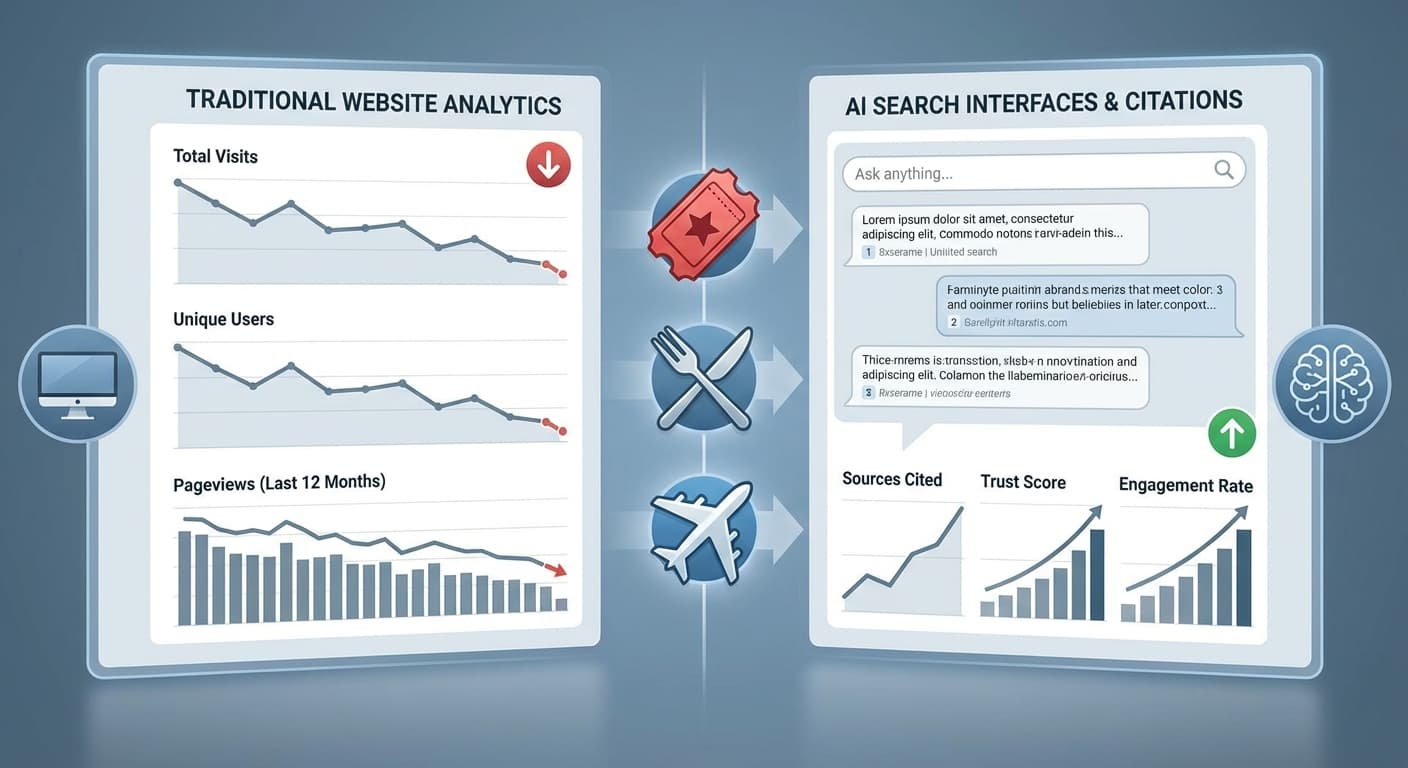
Traditional SEO metrics like keyword rankings and click-through rates don't tell the full story in 2026. Here are the metrics that matter:
AI Citation Rate
Conversational Query Visibility
Semantic Authority Score
AI Engagement Metrics
Tracking Implementation
Phase 1: Baseline Establishment
Phase 2: Optimization Tracking
Phase 3: Performance Analysis
Success Indicators
Look for these positive signals after implementing AI search optimization:
How Citescope Helps
Optimizing hundreds or thousands of legacy blog posts manually would take months. Citescope streamlines the entire process:
Automated GEO Auditing: Get comprehensive scores for all your content in minutes, not hours. Our AI analyzes your posts across all five GEO dimensions and identifies specific improvement opportunities.
One-Click Optimization: The AI Rewriter automatically restructures your content for better AI comprehension while maintaining your original voice and expertise.
Real-Time Citation Tracking: Monitor when ChatGPT, Perplexity, Claude, and Gemini cite your optimized content, so you can measure the direct impact of your retrofitting efforts.
Bulk Export Options: Download your optimized content in multiple formats (Markdown, HTML, WordPress blocks) for easy implementation across your content management system.
Ready to Optimize for AI Search?
Don't let your content archive become a liability in the AI search era. Your legacy blog posts represent years of expertise and effort—they deserve to be discovered by the 850+ million weekly users of AI search engines.
Start your AI search optimization journey today with Citescope's free plan, which includes 3 content optimizations to test the impact on your most important legacy posts. Upgrade to Pro ($39/month) to retrofit your entire content library and start capturing the AI search traffic you're missing.